Showing posts with label New Hampshire. Show all posts

Saturday, May 31, 2014

Artifacts and Information: Crossing into the Sciences

 One of the things I love most about being a librarian is the chance to be in the world of Shakespeare one day and to be exploring Marine animals the next. Usually I only get to do this through research, but yesterday they let me out of the school library to take a field trip. As an archivist who specializes in local history, I had quite a treat as we explored the shores of Rye beach in New Hampshire and took a boat trip off the Isle of Shoals. I took the trip in part to help me better assist students with a big biology research project they do each year. What I discovered is that this trip and project lend themselves to collaboration across multiple disciplines. I plan to inject what I learned into the library work that I do.

I started my day by bringing into school a bird's nest I found while gardening. I had been meaning to bring it in to share for awhile, but I think I finally remembered to actually do it since my head was anticipating a day in nature. I think that most people see birds' nests as part of the field of science. When I think birds nest I think about Audubon's drawings; I think about Wonder cabinets, stuffed birds in libraries that were popular in the nineteenth century, the specimens of birds I first saw at the Vanderbilt Mansion where I volunteered in high school; I think about the birds who frequent my garden who are different year to year ["the cardinals won the prized tree this year for their nest"]; I think of the stories behind the places where these animals go; I think of collecting; I think of the human hand in the natural world. In short, I think history.

The most perfect bird's nest I've ever seen. An outside layer
of flowering grasses, then a layer of leaves, then a layers of
flat wide twigs, then soft, fine grass. I want people to see
the information we can get from nature. I also threw in a little
Twitter bird to get my teacher and student patrons to connect
social media to the idea of the bird.
Doing some surveying work
So, it was a treat to visit the New Hampshire coast - so rich in history and sense of place. Students were brought to different stations to learn math and science concepts. History was popping up everywhere. One station in particular made me interject my librarian thoughts. Older students were teaching younger students about the science at the shore. At the salt marshes, they began talking about a business that had dumped sewage into the habitat years ago. The ecosystem was damaged by the actions of that institution. The students' sentences, so sure about their scientific information, were suddenly punctuated with "I think...this is what I was told...this could possibly have happened." I began thinking about our news database. I began thinking about the Portsmouth Athenaeum not far from where we are. I thought about the Seacoast Science Center that must have information about this event in their archives. 

I interruppted, "Finding out exactly what happened here would make a GREAT research project." They stopped, looked at me, said "Mmmmhmmm," and moved on. As a high school teacher librarian, in a moment like that, all I can hope is that I planted a seed in someone's brain. 

A "purring" fish.  Arawana? I'm not sure of my scientific labeling here
On our trip, I got to play with a vibrating fish, a star fish arm, periwinkles, crabs, rocks and more. These are the "artifacts" of my science colleagues. They collect them like I collect books and archives. They collect nature while I collect man-made material culture. Humans are all collectors, categorizers and information gatherers at heart!
It was seeing the Isles of Shoals  that got my liberal arts side purring. Author Celia Thaxter grew up here. This is where she and my beloved Childe Hassam drew inspiration. This is where Thaxter would bring the plants that she loaded on a small boat in Portsmouth to restock her famed gardens each spring. [see An Island Garden]

As we traveled out to the island, I told some of the students, teachers, and chaperones what I knew about Celia Thaxter. Right in this spot was science, math, history, literature and art rolled up and just waiting for us to explore. So much to see. So much information to take in. So much learning to be done!

I look forward to visiting the Island this summer. It's been calling me for twenty years. It's time to land there. Maybe some of my students' thoughts will follow me there too. Maybe there is another field trip in order.

***
___________________________________________________________________________

Many weeks ago I promised a post about the right to copy from archival collections. I will publish that post soon. I have been working hard on it and am backing what I know with research. Copyright is a complicated subject, so I do not want to start people off with basic misinformation. Stay tuned...


Saturday, April 5, 2014

More Finds at the Local Historical Society

If an archivist stops to explore the details of every interesting collection in her care, she can get so sidetracked that she gets nothing done. Professionals who care for historical records can sometimes get distracted by our own resources. While our jobs give us access to remarkable and interesting things, our tasks to administer, organize, describe and preserve materials cannot be effectively accomplished if we slow down to take in all the details of all of our artifacts. (Generally, we must leave that to the historians.)  Yet, sometimes when caring for collections, an archivist stumbles across something so remarkable that she is compelled to put aside the "work" aspect of archival work, allowing herself to be pulled into stories of the past - just for fun.

And so I was pulled in when I stumbled across this album at the local historical society. I was recruited by the Society's volunteer curator to use my expertise to help them organize their collections. I work as an information specialist at the high school in the town where the Society resides. I am happy to offer my services to further assist this community. It has supported me in a new career and has allowed me to run with my out-of-the box ideas.  Being an archives volunteer is a new experience for me. As a volunteer at the Society, I get to learn more about this town in which I now spend the better part of my days. I also get to "play" with collections a little more than I ordinarily might as a professional archivist.

Always on the lookout for unique historical records, I was overjoyed to find a fabulous album from the turn of the twentieth century. It highlights the life of a strong local woman. Her photos include images of her school, her job, her native New Hampshire, her pets...Her personality rings through loud and clear. Bonus for me - the artifact was created by a librarian. I identify with her. The album's designer shares her curiosity, sense of world wonder, passion for her home state, a sense of adventure, a sense of fashion, and fortitude. She is a woman on the edge freedom - a young woman who seems to have a fighting spirit of independence and likely interest in women's rights considering the era, her job, and active lifestyle.

The album is a labor of love with beautiful handwritten descriptions. A local man, another person with expertise who serves as a Society volunteer, noted how the album is a specimen of folk art, as lovely for its artistry as it is for the information it contains.

At 5:30 one day this week, working with the local library director on an archival survey -- both of us covered in cob webs, dust and mold -- I called it quits for the day. I declared that my reward for wading through the work would be to clean myself up and look through the remarkable album that we stumbled across on an earlier visit.

Our new librarian friend stared out at us through the camera that captured her one-hundred years ago. She captions her portrait "my new bathing suit." The suit reminds me of my favorite vintage shop, which happens to be posting bathing suits this week in preparation for the warm weather. I imagine that this librarian buried in the sand is in Hampton, a small stretch of seaside between Massachusetts and Maine that we call "our beach." I take my daughter there each summer. I'll remember this lady's bathing suit when I put mine on for the first time this year.

I am hoping to research this new found historical friend. I wonder if much information exists about her in library records. There is a lot to wonder here.

I wonder if we would have gotten along.

I wonder how she would have felt about me looking at her album. (It seems like it was meant to be shared.)

I wonder if her relatives are still in town.

Maybe this isn't all "just for fun"...I wonder if I can help my students feel a connection to this former resident.

Despite all the questions, one thing is clear. This lady had a sense of humor. She ends her album by saying, "Is this the end" Now wouldn't that get your..." and beside the written words is a photo of a goat.


Whether she would have appreciated me or not, I am glad that she reached through time and I am a recipient of her wit and charm.

**

[I hope to share photos with you soon. One problem with this information age is that it is too easy to pull out your camera to take photos and post them on the Internet. But permission should be sought from institutions' collections and the best photos possible should be used. Also, policies should be in place for the handling and publication of materials before such publication is done. I will talk about all of this in my next blog post.] 


Tuesday, May 29, 2012

Cemeteries at the Heart of Communities

Turkey Hill Cemetery, Merrimack, NH
The study of gravestones and cemeteries is a field close to my heart. As an undergraduate, I was first introduced to the idea of studying the art of gravestones in an introductory American art history class. I chose that topic for an independent study project, received a stipend to write "Gravestones: A Reflection on American Lifestyles," and the paper was accepted for presentation at Caltech's Undergraduate Research Opportunities conference in 1991. That was a long time ago, but visiting graveyards has been a consistent part of my adult life and burial grounds remain enchanting places for me.

Why do I like graveyards?


Nature and man live together quite comfortably in our graveyards
  •  They help people be remembered how they want to be remembered. Whether we wish to reach out to a God, to be remembered for our good deeds, to mention our connection to family...the gravestone often becomes the place to display our legacy, literally in stone.
  • They are quiet peaceful places that invite contemplation of all sorts. In a graveyard, nature and humanity are often tied together. We can feel something bigger than ourselves and beyond ourselves. (I like to write in a cemetery whenever I can, for this reason.)
  • Like most things created by humans, gravestones reveal trends in tastes and design. We can track changes in history and views by examining gravestones.
  • Gravestone art is really, really amazing. We see carvers' talents on the stones. We can follow these artists and their journeys up and down the coasts or inland. We see how the fine art of the times influenced iconography. The symbols the artists placed on gravestones also reveal much about their times.
Gravestone iconography reflects trends and artists
  • Epitaphs are often poetic and/or funny. 
  • The old-fashioned names on stones are beautiful, interesting, or enlightening.
  • I feel connected in a graveyard, to both the past and the future.
Names on gravestones are fascinating
This morning I had the opportunity to visit Turkey Hill Cemetery in Merrimack, NH. I pass by this site frequently, but I didn't have a chance to visit until today. It was perfect. It's a drizzly day - perfect cemetery weather. 

With some research on the Internet at home, I was happy to see that my genealogist friends have been hard at work mapping this site. I would love to see some straight-on black and white photos that can best show the imagery. I also hope that the town can spend some money to clean the lichen off the stones. We are very lucky to have these precious artifacts right in our own backyards. I hope that everyone recognizes their historical value. (See my article on Copp's Hill burial ground for more reflection on this.)

The connection between archives and gravestones is always fascinating. As with other artifacts, archives help us better understand their history. Whereas the documentation for other artifacts is sometimes difficult to find, records about American graveyards is usually found in town records, family papers, and church archives. In Merrimack:

Information about Turkey Hill Cemetery is posted at the site
"The first burying ground mentioned in town records is that of the meetinghouse, located on Meetinghouse Road near where it joins Turkey Hill Road. It is now known as Turkey Hill Cemetery."

In a way that few other places can, a graveyard supplies a sense of community space. This is the last and most important reason why I love them. In early New England, a church was a requirement for the establishment of a town. Churches were usually placed in a centralized location that was at least somewhat convenient for most people. Located beside their churches, New Englanders established their first graveyards. This allowed families and loved ones, neighbors and leaders to remain close to those in the community even after death. Graveyards link us to "them" and link us to others who remember and bury their dead around the world.

Monday, December 20, 2010

Community Art

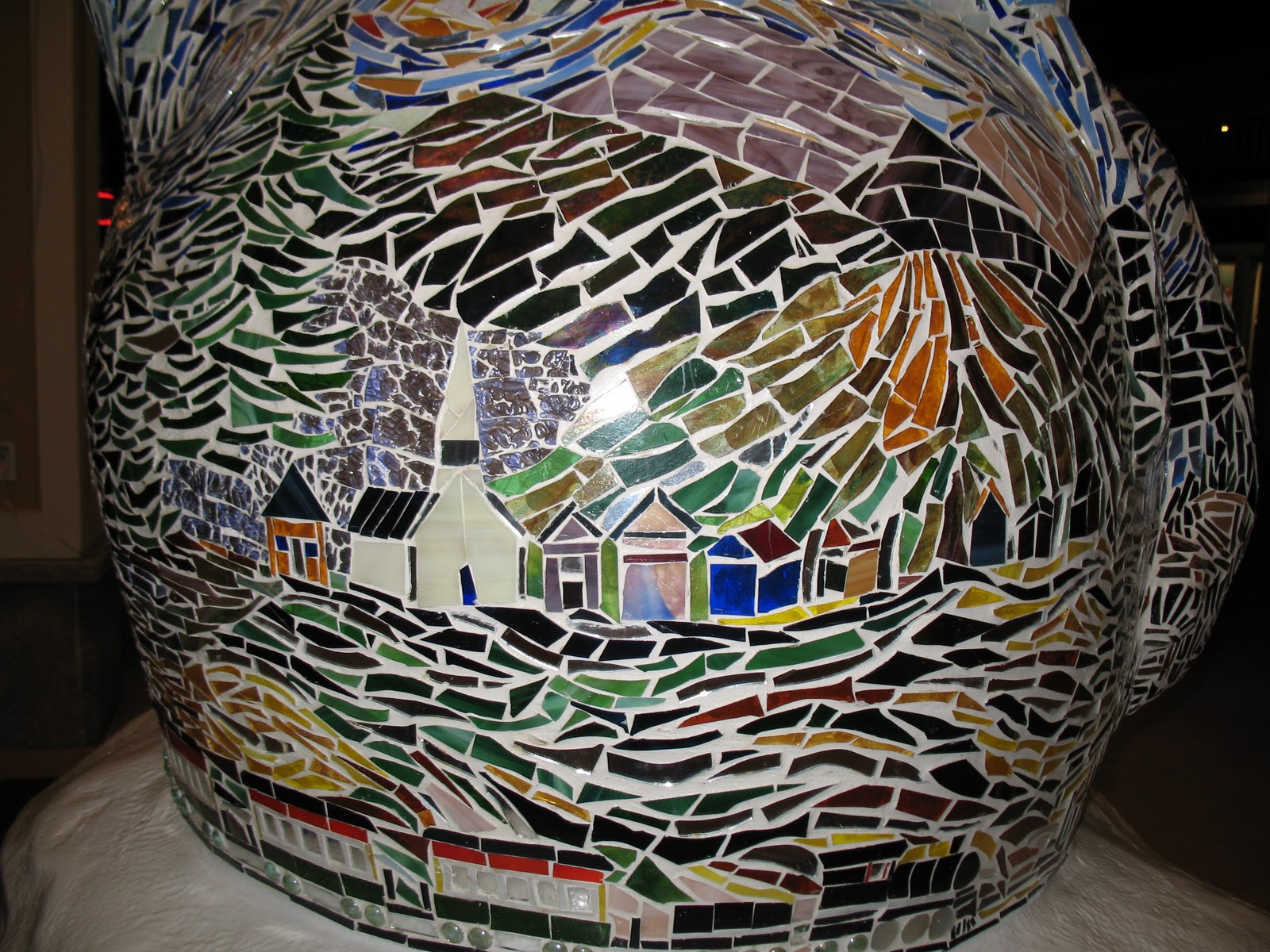
My favorite snowman of all the snowmen on parade was inspired by my favorite expressionist and one of my favorite artists.

Expressionism was given a distinctly local flare with images of New England style churches, homes, and covered bridges, which are a particularly valued part of New Hampshire heritage.

This past weekend, I visited North Conway, New Hampshire with my family and was pleasantly greeted by the community's Snow People on Parade. We saw snowmen sculptures near our hotel, near local shops and restaurants. We found ourselves seeking them wherever we went, hoping to get pictures in front of them all. The snowmen added to the festive feel of the area.

This small tourist center nestled in the heart of the White Mountains was made for Christmas. Snowcapped peaks helped us dream of a white Christmas that contrasted greatly with the brown we still have over much of New Hampshire. The art of the snowman is a clever way to emphasize this community's strengths while supporting the local creative economy. The town benefits from the beauty and charm of the winter artwork and the promotion of local identity as a winter destination. While visitors tend to flock toward the area in the summer for its shopping and outdoor activities, winter is usually reserved for the skiers who stay at the nearby mountain resorts. The presence of the snowmen adds a new dimension to my feelings about the place and will encourage me to return during this sleepy time of year.

The snowmen reminded me of a public art display that I saw in Washington D.C. many years ago. In 2002, the city commissioned 100 elephants and 100 donkeys from local artists to display for public enjoyment. It was exciting when my husband and I found new sculptures and it filled me with pride to see my country displaying a piece of its identity in a lighthearted way.

When I mentioned the snowmen on the phone to my mother, she told me about another public art event down her way in Florida. Bradenton holds a bi-annual Geckofest where local artists create their impressions of the adorable local creature that can be found throughout the region. Gecko art is displayed in local buildings and then auctioned off to raise money for county art organizations.

Public art exhibits like these raise awareness of cultural identity and celebrate community pride. They can serve to highlight a particular aspect of a community that one wishes to promote. Public art exhibits can be a valuable outreach tool and increase interest in local art and heritage. Cultural institutions may want to consider collaborating with area artists to create unique displays that will benefit their own organization, their community, and their visitors.


Monday, June 28, 2010

More Finds at the Local Antique Shop - Provenance

This curious image caught my eye at the local antique shop. Do you spot something odd about it?
Why is the girl in the front row holding a "No Hunting" sign?

Otherwise, this class (supposedly graduated from a New Hampshire school) strikes me as rather ordinary. Typical hair, dress, and dark lipstick of the period in a rather ordinary New England room, with steamers that provide a clue about a celebration of some sort. The image is interesting from a provenance perspective. In fact, all images that end up at the antique shop interest me in this way. How do people's private images wind up here? Would they miss them? Would they be upset to know that I am evaluating them?

In the archives field, "provenance" is important for determining the authenticity of materials and for understanding the contextual value of items. If I were to do more research on this image, I would start with the information given to me by the antique dealer. The dealer's label reads "circa 1940s Lakemont Academy photos." As an archivist, I would not presume that this is factual from someone else's identification. If I cared to take the time for my personal collection (or were managing a collection in which this photo would serve as documentation of a community), I would try to confirm what the dealer has told me. To do this, I would need to find other similar collections. by contacting the dealer to ask from where he got this material. Then, I would contact the family, collection, etc. from where he said it originated. Or, I would contact the Lakemont Historical Society or another repository in the area and seek similar collections to compare the faces in the photo and find out more information about the Lakemont classes from the 1940s.

The first image was accompanied by a second one and the two were sold together for ten dollars. (Overpriced, I think, but I was really curious about that "no hunting sign.") The second image is of the school's basketball team. Some of the boys appear in both photos, and the basketball shirts do say "Lakemont," making me more confident about their origin. But the more information I could gather about the items the better and I would work to unravel the puzzle until I was confident about the items' origin - putting the images into context, learning more about this class, and perhaps learning how the antique dealer came by these images.

Confirming provenance gives users of archival material a context. Random photos found in an antique shop may not be interesting until we can relate them to ourselves, our community, or a personal interest. A fellow Lakemont grad or basketball team member may have found this fascinating despite their initial ordinary appearance.

Or, than again, that "no hunting" sign may have been enough to pique someone else's curiosity...

Friday, March 19, 2010

Antiquing from an Archivist's Point of View

The antique dealer said to me, "So you must be from Dover," as I fingered the dull medal and tried to decide if it would suit my purpose.

"Um, no I'm not," I replied.

He stood beside me waiting for me to tell him why I was interested in the little New Hampshire Old Home Day souvenir, his curiosity now piqued, I guess. I considered whether I wanted to explain it all again, as I had done so many times before to so many different types of people.

"I'm an historian," I said, "I'm interested in things." Did I really want to teach what an archivist is when I was supposed to be enjoying a morning away from the office?

The dealer was satisfied and just told me to let him know if I needed his help. I wandered the aisles of the little antique shop on Route 4 in New Hampshire, known in this state as "Antique Alley." I peered in little glass display windows seeking mementos that would help illustrate my book about documenting communities and items that could possibly used in my classes to teach students about the importance of archives and preserving personal papers.

My closest friend was accompanying me on this trip. She has no background in what I do, but is trying to understand. "How about this cute postcard for the book?" She asked. I looked over her shoulder to see the Norman Rockwell Christmas card she held.

"I can't use it because of copyright issues," I said.

"Oh." We wandered some more. "Ooh! Here are the letters you need!" She exclaimed. I had told her that old handwritten letters would be perfect. So I again sidled up to her and this time saw the old town records she was examining. I hope that I stifled my sigh.

"These shouldn't even be here, although you'll find municipal records in shops like this all over the place and on E-bay." I explained, "These are the legal property of the town that created them and should be returned." I also explained this to the proprietor to whom I then had to explain what I really do.

"I'm an archivist and we manage records such as these. They really should be returned to the town. They are an important piece of documentary heritage." The shop owner thanked me kindly and said he'd notify the seller. He was nice about it at least...didn't harumph at me or anything.

I left the shop with my Dover medal, two lovely black and white images, and a small tin type. I always wanted a tin type. This one does not have its full case, but the frame and the little woman staring back at me are beautiful. It's always nice to have my own special bit of history to share. As an archives consultant, I don't always have archives and manuscripts at my disposal to use as samples for explaining. So I build my own "collection" and try to find items that are meaningful to me in some way and it makes the process of "collecting" more worthwhile - fun, memorable and educational.

My day on Route 4 was great. We found another little shop with more town public records and this time my friend jumped all over it. "Look! You had better tell them about these too." We then left for a great lunch in Concord at Siam Orchid Thai on Main Street. ( I highly recommend this restaurant by the way - super yummy.)

This morning I scanned my treasures to share some with you. And now I have also done my personal "educational" part. I love New Hampshire Old Home Days. I grew up in New York and there we had fireman parades and fairs where our town's heroes could show off their equipment. I suppose the point was to encourage us to keep supporting their purchases. They then held a big carnival to entertain the local kids. Old Home Days in New Hampshire has a similar atmosphere. According to a little research, (very little research to be exact - not up to my usual, but I'll save that for another day should my interest in this topic grow further) Old Home Days were started at the turn of the century, supposedly to encourage children who were leaving home in increasing numbers to come back to visit their families. Towns all over New Hampshire began having big celebrations to show off their towns and welcome back children for reunion (sort of like school homecomings, I guess.) Old home days can stimulate the economy, raise local awareness by encouraging groups within a locale to participate, and raise civic pride. Old Home Days can be a central part of a movement to stimulate cultural awareness and thus my little Dover medal has special meaning for me, someone who works primarily to promote cultural heritage. My antiquing is never straightforward.