Showing posts with label visitors. Show all posts

Tuesday, February 21, 2012

How to Attract an Audience? Is a Picture Worth a Thousand Words?

Seacoast Science Center, Rye, NH.
One of my favorite online  images
of a patron interacting with collections.
Take a look at your web site. Is it visually interesting?

While I have always appreciated images and good design when I visit a web site, the importance of those things has been emphasized as I search for good images of cultural heritage topics to fill my Pinterest boards. Don't worry. This is not another blog post for Pinterest, but what Pinterest has made quite clear to me is the value of including fabulous, interesting, and provocative images on our web sites (and our blog posts) to attract patrons.

Archivists deal quite a bit with text. Many of us care for documents and words more than we think about images. Librarians have the same issue. Our professions value "information" - a "thing" that is difficult to define, much less ascribe visual labels to it. However, images can be a major selling point for our work. Museums seem more likely to know this instinctively. They include images of artifacts on their home pages and pictures of people interacting with them. Archivists and librarians need to pay attention to this and to find ways to make their sites more appealing -- so people stick around to actually read the information part. It is very easy for potential patrons to click off your site. If you don't capture someone's attention in the first few seconds, they are likely to just go away. A picture can draw someone in faster than a word by quickly pulling on a heart string, exciting artistic sensibilities, or quickly engaging curiosity.

I realized as I was pinning that the uptick in the use of this new pinning technology is a chance for cultural heritage repositories to encourage individuals to explore their actual web sites more fully through pictures. In fact, anyone who has a web page to provide information that aims to invite visitors to a place should pay attention to their imagery as well as their words. Through my Pinterest work and the browsing I did to write this post, I understand more fully that people who come specifically to check out our web pages because they are interested in our institutions will be turned off by BORING. If your web page is boring, why would I want to see your museum, library or archives in person? Why would I want to extend the experience you are providing to have it in person? Does your web site tell me, perhaps even on a subconscious level, that you are NOT worth my time?

Archivists, don't just put your finding aids online and wait for them to come, unless of course you are only seeking "serious" researchers and don't want to expand your user base. (I realize that this is preferable for some institutions for many reasons.) Libraries, please do more than post the hours you are open. Use your collections to visually explain why you are fabulous. Show your patrons learning and having fun.

  • Post pictures of your institution
  • Post pictures of your collections
  • Post pictures of your staff
  • Post pictures of people in your institution, interacting with your staff and your collections
Below is a list of a few institutions in New England that I think are doing a great job with incorporating images onto their site to explain who they are, what they do and why we would want to take part. I have not evaluated the sites themselves for usability or information, but I was impressed with the kinds of images they showed. I found them inviting. I also tried to choose places with varying budgets to show that you do not need a large budget to find, make, and use great images of happy people and places. You can have a fancy Java driven web page, a Flickr photo stream, or just a simple html document. Images help give each web site a little character and make each institution more alive and welcoming.
And now I'm off to scrutinize my own web pages....I know that they need a little help.

Tuesday, January 18, 2011

Open House at the Museum of Fine Arts, Boston - A Family Visit

I spent yesterday on a family trip to the MFA's special Martin Luther King Day open house. It was my first time visiting the Museum since the opening of the new American wing. I interned in the archives at the museum for two years in the early 1990s as a graduate student and made many trips here as an undergrad art history student in New England, so I hold a special affinity for the place. I do not make it down as often as I would like to now and it always feels like a coming home of sorts when I enter the building.

This is still the old museum I know, but it has been pushed to exude the world class status that it should be afforded because of its remarkable collections. Right from the start, the re-opened grand entrance gives one a sense of entering a remarkable institution. The addition of the building has retained the feeling of the original building, but with spaces molded specifically to frame the collections for which Boston is best known. Sargent, Copley and Cole are among the American "masters" that are now afforded more room and are properly highlighted as gems among New England's heritage. My favorite works of art, for the most part, did not disappoint me.

This trip with my family invited me to see art through my child's eyes and I therefore did not get to do all the things I probably would have done on my own. I did not get to visit the library and archives to see if there were any changes, to examine label text as closely as I normally would, or to wander in a completely serendipitous way to gain a good sense of exhibit flow. We had specific things we wanted to see before anyone tired and we stopped to see things for which I normally wouldn't stop. There was plenty to keep my seven-year-old engaged. I found that this may be the perfect age to start seriously sharing art museums with a child. We last visited here a couple of years ago and the experience seemed more like dragging her around while trying to anticipate what might engage her. This time she was able to tell us what interested her. However, perhaps if we didn't experience our last trip here (and trips to the Philadelphia Museum of Art, Peabody Essex and a few others in between) she still would not be in a state of mind to start appreciating art on this level, learning and taking a deep interest in the exhibits.

A free open house is not an ideal day to examine my favorite paintings. There was much jostling to see more familiar works. In fact, there were few quiet places in the museum at all. The American wing was the most popular spot, but there were people everywhere. I found some respite in the rooms of Asian artifacts, but if I were attending for any kind of meditative experience there, I wasn't going to find it. As a cultural heritage professional (you can take the girl away from the job for a day of rest, but the mind-frame always stays) it was interesting to see how the public interacted with exhibits. I assume that many people who attended were not regular museum goers, but were encouraged to come here because entrance was without charge. Many people walked around with cameras to engage in a personal way with what they saw. Most seemed to know to turn off the flash. In other cases, I saw people touching statues as in the case of one man who leaned his head on a bust to have his photo taken with it and a three year-old petting the stone toes of an Egyptian saying "foot. foot" while his parents looked the other way. I also saw people lying on the floor and walking around without shoes. All of this is to be expected to at least some extent in such a large gathering and I was happy to see people beyond what we have come to know as the average museum attendee here, but I think the museum needed to be more attentive to the crowds.

Here are a few impressions and highlights:
- I was very impressed with room recreations of beautiful old New England houses. My family and I enjoyed imagining ourselves living in those spaces and admired the true to era wallpapers and decorative sensibilities. The many period rooms added a new dimension to the experience offered by the MFA, allowing us to be enveloped in a specific time as we would in a specialized house museum.
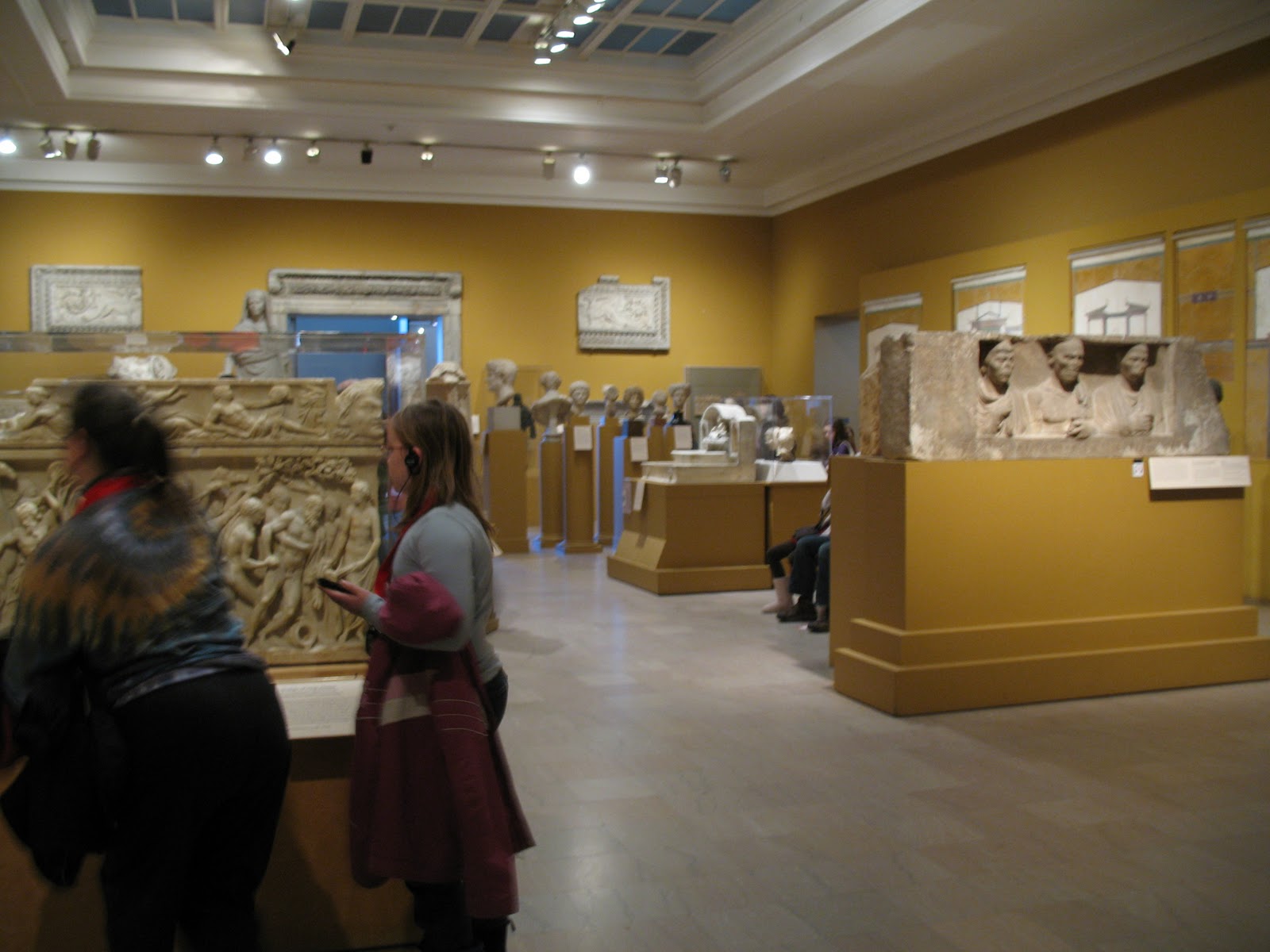
- I was also impressed with new colors in old exhibit spaces. I found the yellow in the Roman section especially dramatic, with a clean / shiny / new feeling that I felt highlighted the objects especially well. Every space throughout the museum was welcoming and collection exhibit spaces as a whole felt more modern and cared for. Even the gray exhibit halls of decorative arts that used to lead me to the archives were gone.
- I was impressed and excited by the number of works that the MFA can now exhibit and that they have taken out of storage. Our prime regional museum should be able to display and show off its best work. It can now do so. The MFA is not only a world class institution, it is also home to New England's most talented artists who should be on stage accordingly here. We have Monets to appreciate, but I'm glad that our American artists now have the prominent wing that they deserve. 
- I was impressed with a combination of media education tools and "on spot" real-person guides. Videos immediately attracted my daughter and taught her all about furniture making. She now wants to give it a try.
- I was not impressed with parking. Parking has always been a problem here and it seems as if issues have not been resolved.  The lot was jammed by late morning - literally. People were stuck at the top of the garage with no spaces and no room to turn around. Cars should have been cut off from this area before this kind of chaos occurred.
- I was also not impressed with the cafeteria. The service was slow and there were no places to sit where we ate in the basement. We should have been informed of the eating space across the museum that we had forgotten about or directed to seating upstairs outside the gift shop. Even though parking and eating are secondary to viewing exhibits, they are both part of the day's experience. The museum seemed ill-prepared to handle this sort of crowd and there was much obvious frustration.
- I was also concerned about the lack of museum guards as we watched visitors' bad behavior. Though I do not like when guards are looming over me, seemingly waiting for me to make a wrong move, yesterday I had the opposite experience. I saw few guards and much behavior that could seriously damage collections. More attention to visitors and even some gentle museum etiquette training was necessary. 
- Finally, some of the lighting was problematic. For example, there seemed to be a glare on Paul Revere wherever I stood.

Despite a few concerns, my family had a wonderful time at the MFA. Snow is falling again in New Hampshire this morning, but I will carry the good warm feelings that the museum left with me yesterday through my day  today. I am anxious to return to Boston to see more -- but perhaps on a quieter day.


See more on the MFA expansion and remodelling

Tuesday, June 8, 2010

Want More Visitors? Don't Be Pretentious

One concept that I was taught as an undergraduate twenty years ago has stuck with me throughout my career. My museum studies professor told us about famed child psychologist Robert Coles who practiced in Boston. He took his patients to the Museum of Arts for his sessions with them. Many of these youngsters lived within walking distance of the Museum, but had never visited. They were afraid to go into the imposing building. Many of them were from underprivileged families. Their parents told them that the museum was for other people and not for them. They couldn't relate to it. The institution seemed pretentious.

Coles set out to break down barriers by bringing his patients to the museum. His visits helped raised the self-esteem of those he introduced to the institution's remarkable holdings. He sought to raise the bar for their visions of the future by allowing the young visitors to realize that these resources were meant for them too. They could appreciate aspects of the same culture that wealthier patrons enjoyed. They shouldn't feel shut out. They too could be uplifted by the creations of men and women, some of whom had backgrounds similar to their own.

Cultural institutions walk a fine line between inspirational culturing and pompousness. It is a line about which we should always be aware. We should aim to inspire and educate, but we must do so with an eye toward relating to an audience on their level. We should give patrons something to relate to with high culture peppering our efforts when appropriate.

This past weekend, my husband and I went to see the re-release of "Metropolis." Released in the 1920s, this German silent movie tells the story of class distinctions with a sci-fi bent. The movie is 3 hours long. After waiting in line for an hour at the Coolidge Corner Theatre to get good seats, we were "treated" to a half-hour diatribe about the film before we got to see it. For one, I just wanted to see the film. As a former art history student, I am not always put off by highfalutin lectures, but that was not why I came to the theater that day. For another, I had already read about most of what was told to me in the lecture. The movie was going to be long enough as it was. To be sure, most of the audience was made up of geeks like my husband and me. If they wanted to know more about the film, they could have researched it when they got home.

The role of a cultural institution is to present culture and help start a conversation about it. If the audience wants to evaluate the high brow merits of a film, they will find a way to do that. All you have to do is give them an outlet. It doesn't have to be an in-your-face presentation. If the audience doesn't want erudite, don't turn them off to your institution by forcing it down their throats.

Here's another example...about two years ago, I took my four-year-old to see a local ballet production of a fun fairy tale. My daughter was just starting ballet and I thought it would be fun to amend her studies with a trip to a performance. The first hour of the production included dances from Swan Lake and other famous ballets. The dance we came to see was last. Nothing in the advertising for the program told us that they were going to include anything other than the fairy tale. By the time what we came to see went on stage, my girl was wiggling and no longer interested. Did the ballet win a little fan by trying to culture us or by showing us what they were capable of doing? No. In fact, we will never go see one of their productions again.

We run the risk of driving people away when we insist on promoting high culture without thought to relating on the audience's level. More troubling to me, when we aim to show off the refinement all cultural institutions can possess, we can make many people feel excluded. A cultural institution should be about inclusion and not exclusion. If you show your visitors how your holdings and activities are about them, people are more likely to relate to you and support you. Aim to demonstrate that your institution is a reflection of humanity, showcasing items made by people like you and me -- perhaps these creators had a special talent, but they are still only human. In general, people don't like pretentiousness. We can usually spot it a mile away and if you are like me, you try to keep your distance.