Monday, December 20, 2010

Community Art

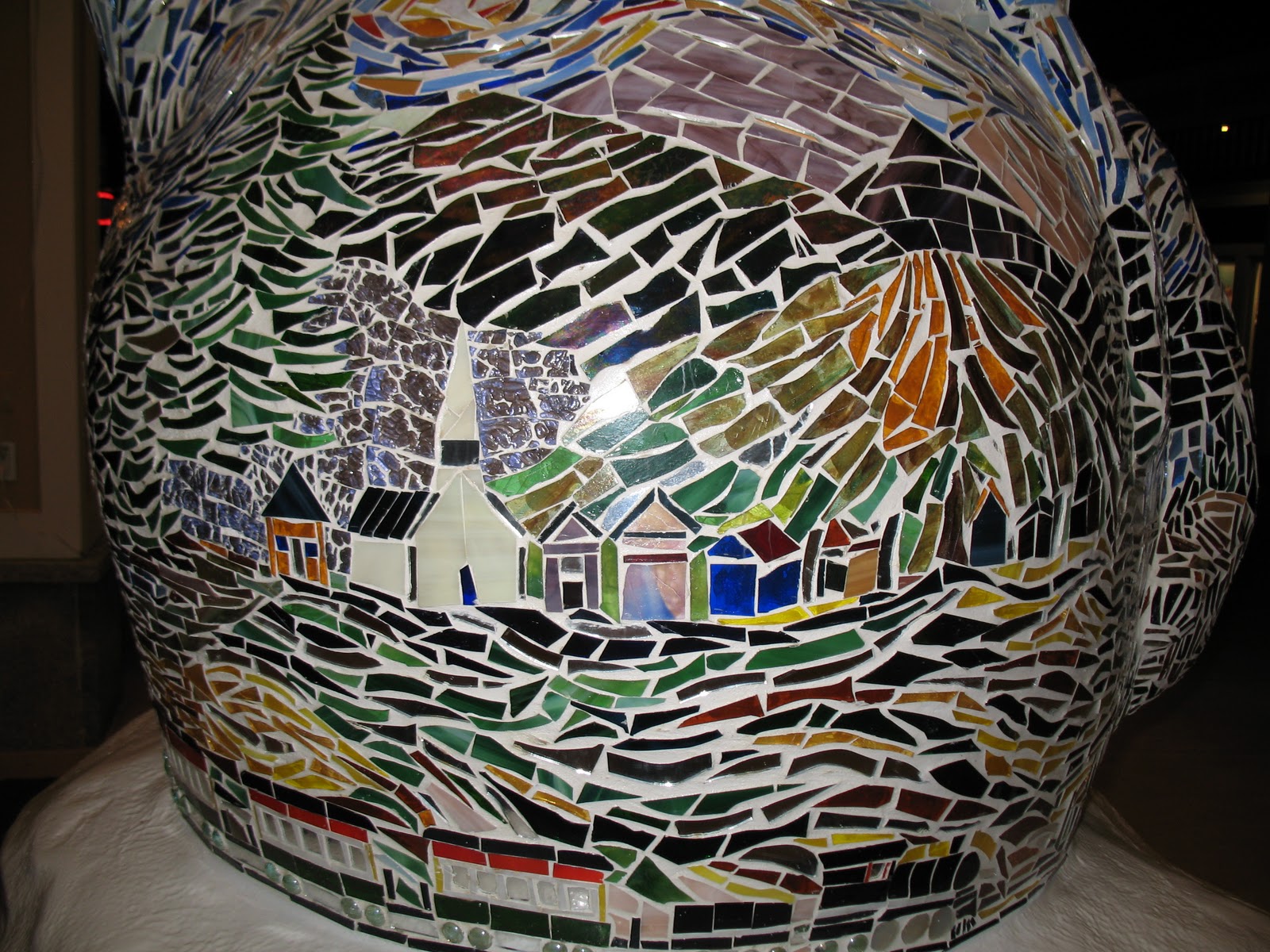
My favorite snowman of all the snowmen on parade was inspired by my favorite expressionist and one of my favorite artists.

Expressionism was given a distinctly local flare with images of New England style churches, homes, and covered bridges, which are a particularly valued part of New Hampshire heritage.

This past weekend, I visited North Conway, New Hampshire with my family and was pleasantly greeted by the community's Snow People on Parade. We saw snowmen sculptures near our hotel, near local shops and restaurants. We found ourselves seeking them wherever we went, hoping to get pictures in front of them all. The snowmen added to the festive feel of the area.

This small tourist center nestled in the heart of the White Mountains was made for Christmas. Snowcapped peaks helped us dream of a white Christmas that contrasted greatly with the brown we still have over much of New Hampshire. The art of the snowman is a clever way to emphasize this community's strengths while supporting the local creative economy. The town benefits from the beauty and charm of the winter artwork and the promotion of local identity as a winter destination. While visitors tend to flock toward the area in the summer for its shopping and outdoor activities, winter is usually reserved for the skiers who stay at the nearby mountain resorts. The presence of the snowmen adds a new dimension to my feelings about the place and will encourage me to return during this sleepy time of year.

The snowmen reminded me of a public art display that I saw in Washington D.C. many years ago. In 2002, the city commissioned 100 elephants and 100 donkeys from local artists to display for public enjoyment. It was exciting when my husband and I found new sculptures and it filled me with pride to see my country displaying a piece of its identity in a lighthearted way.

When I mentioned the snowmen on the phone to my mother, she told me about another public art event down her way in Florida. Bradenton holds a bi-annual Geckofest where local artists create their impressions of the adorable local creature that can be found throughout the region. Gecko art is displayed in local buildings and then auctioned off to raise money for county art organizations.

Public art exhibits like these raise awareness of cultural identity and celebrate community pride. They can serve to highlight a particular aspect of a community that one wishes to promote. Public art exhibits can be a valuable outreach tool and increase interest in local art and heritage. Cultural institutions may want to consider collaborating with area artists to create unique displays that will benefit their own organization, their community, and their visitors.


Thursday, December 16, 2010

More Finds at the Local Antique Shop - All Dressed Up with Someplace to Go


I love this group photo of people all dressed up in fancy winter attire.  Elaborate hats, bow ties, and groomed mustaches add to the charm of the scene. The first thing I thought when I saw this in a shop a month ago was that perhaps those pictured were heading out to church on a snowy Christmas morning. Someone took the photograph to document the special occasion. It seems appropriate to post the image now with the holiday only a little over a week away.

Christmas seems to be one of the few times we care to dress up any more. Where people once prettied themselves to go to dinner, travel, and even go to work, today we are quickly losing this aspect of human culture. Almost all the restaurants I frequent are casual. Comfortable dress is the ideal on a plane or cruise ship. Suits are becoming less and less the norm for everyday business wear. Images such as the one above remind us why it is nice to sometimes be formal. There is something special about seeing people in their finery. Taking care of our dress reminds us of the occasion in which we are participating, heightening our awareness of self and our sense of place.

Tuesday, December 14, 2010

Censorship is Always Wrong

Censorship hit close to home yesterday when a book was challenged  locally. Articles have appeared around the world about the controversy:
Boston: New Hampshire Parents Object to "Offensive" Book: http://boston.cbslocal.com/2010/12/07/nh-parents-ask-for-book-to-be-removed-from-class/

When I heard about the issue, the hair on my arm prickled. I have not read the book, but as a librarian/archivist I fall strongly on the side of intellectual freedom. This was the first time that book banning had become more than business or more than an abstract possibility in my community. It had become personal. A challenge to my right to read what I want, and more importantly a challenge against my child's right to be given an education through every book she can get her hands on, is frightening to me. I do not want an ugly precedent set here in my small NH town.

I wrote to my school board to express my opinion that children should be exposed to diverse points of view.  I plastered my personal social web space with quotes from the American Library Association.

‎"... the freedom to read is essential to our democracy, and reading is among our greatest freedoms...every silencing of a heresy, every enforcement of an orthodoxy, diminishes the toughness and resilience of American society and leaves it less able to deal with controversy and difference...intellectual freedom is essential to the preservation of a free society and a creative culture..." - American Library Association 
http://www.ala.org/ala/issuesadvocacy/banned/bannedbooksweek/ideasandresources/banned_books_week_proclamation/proclamation.cfm
http://www.ala.org/ala/aboutala/offices/oif/statementspols/ftrstatement/freedomreadstatement.cfm

Many people had lots of thoughtful things to say on a local Yahoo web site. Many people with very diverse political and religious views fell on the side against censorship. A friend responding to my ALA posting summed it up appropriately, "Censorship is always wrong!"


1. If we value personal freedoms, as we claim to do in our democracy, we must also make an earnest effort to accept that our fellow citizens have diverse views.
2. School (especially high school) is the proper place to introduce materials for discussion that encourage logical thinking. One does not need to agree with material that is introduced, but should reflect upon it and use critical thinking skills to evaluate it. This will strengthen our understanding of ourselves and of those around us and allow us to make better informed decisions.
3. We all bring our own personal and community experiences to our efforts to evaluate our reading, but rejecting a point of view because it is not your point of view, uses language you wouldn't use, or is borne of a lifestyle with which you think you can't identify, is irresponsible. Strengthen your ability to make logical choices for yourself, your family, and your community by trying to understand why others have alternate opinions.
4. Trying to ban an argument that is not your own without consideration does not help your own cause. One should take in alternate views to make your own argument stronger. Rejecting the opportunity to read all kinds of information does not make you a better person. It makes you a dumber one.
5. Listening to alternate perspectives also prepares you to deal with movements that undermine you, your lifestyle or even your safety. Silencing your "enemy" does not make your "enemy" go away, it just sends the enemy underground. Open discourse helps disperse hostility.

I am pleased that the book will continue to be used in our school for now. It sounds like logical heads are  discussing the value of this particular book. I hope this discussion opens new doors for learning for me and for those in my community.

Wednesday, December 8, 2010

A Gift of Ephemera - Replicated Antique Christmas Cards

As I sat in a class on antiques earlier this fall, the instructor showed us a replicated artifact. A question about the motivation for making copies of historical items ensued and over the length of my 6-week course the subject of copies was re-visited over and over again. At one point, I raised my hand to give my two-cents as a history professional with an alternate perspective. We are all aware of forgeries, recognizing the desire for some to dupe professionals or to con eager buyers of materials to make a buck off of them. Museums, libraries and archives often run into objects of questionable authenticity. (Off the top of my head I can think of at least two very recent inquiries into the authenticity of found Picasso drawings and Ansel Adams photographs.) However, I was realizing that the people interested in antiques were seeming to consider all replications as "forgeries." I had never really thought about this before this time.  Replications are not always created with malicious intent and can be a boon to historical institutions that wish to share what they have. Yes, of course, cultural heritage institutions re-create and sell items to make a little money in the process, but there is no design on passing them off as the real thing.

The original item shown in the class was a kitchen aid from the 18th century. (Unfortunately, my full memory of the object itself is faulty so I'll make no pretense to state exactly what the item was, but as I remember it it was some kind of stone trivet or pan.) The "forgery" looked to me like something I would pick up in a museum gift shop. The instructor told us that often such items are made in China and flood the market with the intention of duping prospective collectors of a popular item. The popularity of specific items ebbs and flows, so the U.S. market could be flooded with different items that make their way into the antique world and float around for ages.  So this all got me wondering, how often do the items that museums create for their gift shops fool people who think they are the "real McCoy."


Above are antique "replica" images with full disclosure intact on the front of the item. Though I'm pretty sure that no one would confuse this with the real thing, in light of my antiques class I am glad that it is blatantly put out there. This is a booklet that was given to me by my friend Regina as an early Christmas present. (She was so excited to give it to me that she couldn't wait and her enthusiasm, as always, was infectious.) The booklet  includes 6 pages of perforated and replicated cards. Each postcards says "Merrimack Publishing Company, N.Y...Printed in Hong Kong. REPLICA OF ANTIQUE ORIGINAL." They REALLY want to make sure that you know this is not the real item, but there is no mention of where the real items are located. 

A quick Internet search of "Merrimack Publishing" did not yield detailed information about the company itself, but the search did reveal that most of their items were selling in out of print bookstores. Items included replicated ephemera similar to mine, reproduced children's and history books. The word "Replica" appeared over and over. I also did a quick business search through my local library's databases to no avail. I am still left wondering where the originals of my replications are housed. I will probably trot to my local library later to see what I can dig up in traditional sources.

Ephemera is a wonderful gift that can be quite meaningful. The historic images in my item are lovely. Should I mind that they are not original? Perhaps not, but I would love my item better with a history and if I find out more about the publishing company that might be good enough for me. If I can find the location of the original items, that would be even better, but I'm not sure how much time I will devote to that task... It is interesting to see the old-fashioned images that are really flaring up my Christmas spirit and the generosity of my friend in thinking of me when she purchased these makes them extra special. Though I don't get the excited feeling I generally have when I touch something old and can dream about the people who touched it before me, there is certainly much to appreciate in this replicated historical item. My daughter will certainly admire the cherubs and Santa when I show this to her. The replica will be a useful tool to teach children about archives...I just wish that I hadn't seen one perforated card from this book advertised online for 9 dollars. I am left with my torn antique class feeling all over again

Tuesday, December 7, 2010

A Gift of Ephemera and a Little Research

It's the gift giving season and my friends are being quite thoughtful...

A few weeks ago, my friend April mentioned some "antique" cards she had. She purchased them as a teen because she thought they were pretty. She's carted them around to new homes with her for years. She's wondered about their age, thought about them little, and thought perhaps I would put them to better use. I jumped at the chance to add these items to my collection of archives and ephemera. Thanks April!

The first thing I wanted to do was to find the age on the items, so I could at least give my thoughtful "gifter" that information in return for her generosity. This set is lovely and complete, including birth announcements, envelopes (with glue bleeding through seams from age, composition, and deterioration), and the original box. I first looked up "Baby Batiste" on the Internet since this is what is written on the box cover. Dead end. I then noticed in little words on the side "Hobby Stationers Inc." I decided to pursue this route and came up empty handed with an Internet search. However, right below the company name is written, "Colorado Spring Colo." I used the Internet to locate a library in Colorado Springs. I requested any information the librarians could find about the company. Within a day, Sandy of the Special Collections at the Pikes Peak Library had pulled three articles for me. According to the first article, Hobby Stationers came to Colorado Springs from Kansas City in 1946. This told me that my stationery was made after that date. The second article told me that the company were the "largest manufacturers of humorous and novel stationery in the country," so I know these are not unusual and are more likely a typical sample of stationery from 1940s-1970s -- a perfect specimen to share with students who take my "Preserving Memories" classes. The final article showed me the new home of the stationery company as it appeared in 1947 and included photos of workers creating their stationery. What a lovely bit of history to go with the original item! Thank you Sandy for providing the wonderful information so quickly, proving once again that librarians and archivists are efficient, hard working, and a valuable resource!

Later this week on the ArchivesInfo blog..."A Gift of Ephemera - Replicated Antique Christmas Cards" (from my friend Regina)

Thursday, December 2, 2010

"A Fire in My Belly" - Culture in Context

There is a story in the news this week that really has me thinking and has me troubled. It is not a new story, but it this is another chapter in an ongoing saga concerning: 1. What is art? 2. What cultural collections and programs should the federal government support? And most fundamentally 3. What is the role of a cultural institution?

The National Portrait Gallery recently removed the video "A Fire in My Belly" from their exhibit, "Hide/Seek: Difference and Desire in American Portraiture," after complaints by the Catholic League and members of Congress who claimed it was sacrileges. According to the Washington Post, they object to "Homoerotic images" and refer to the video that includes ants crawling over Jesus on a crucifix "hate speech." According to National Portrait Gallery Director Martin Sullivan,"A Fire in My Belly" is a video that depicts the suffering of AIDS victims.

After watching "A Fire in My Belly", I am struck by the emotion it captures. There is a lot to take in here and I will have to watch it a few times to interpret everything. I also do not want to re-write my art history thesis and bore you to death in the process, but these are the things that struck me most:
1. In addition to images of Jesus, the video also shows two halves of bread being sewn together. This imagery is reminiscent of that of Frida Kahlo, an accepted great Mexican artist who created multiple self-portraits of herself broken and stitched after an accident that left her in pain for most of her life. The inclusion of this can be taken to symbolize a feeling of being broken or un-whole.
2. The artist also includes images relating to the Mexican celebration "Day of the Dead," further tying him to the Kahlo school and exploring notions of dying. Death symbols appear over and over -- hollowed pale dead faces with empty eye sockets are startling and poignant. Images that make us think of pain include lots of blood as the artist struggles with what members of his community must endure in the present and what they may find in their future. He struggles with the body as a shell, showing cleaned carcasses of meat that juxtapose against the warm bodies, active suffering, and more disturbing images of death.
3. Bugs do not only appear crawling on crucified Jesus, but also on skulls and candles. A cockroach appears belly up later in the film. I remember that I have heard that this bug will survive even a nuclear war and will long outlive my species, which is shown going up in a fire-y ball of earth at the end of the video. To me the bugs symbolize the slow creeping of disease and helplessness.
4. We are reminded of the artist's sexuality, which was once blamed for this new "plague" and which he shows us through the image of a man pulling down his pants and masturbating. Again, the artist is providing a blunt look at his world. I am disturbed, but reminded that this is his point of view not mine. He challenges me to look and to feel his pain.
5. Music accompanies the video and it is deeply disturbing. The word "unclean" and quotes from the Bible are reiterated. I wonder if the artist is struggling with who he is and what is expected of him. I do not immediately jump to the conclusion that he is angry with those who condemn him, though this may be part of what he feels. The theme of cleanliness appears in the imagery too with purifying fire and hand washing scenes. I wonder if he feels unclean or has been told he is unclean or perhaps both.

I am left considering the artist's emotions. He is taking in the pain around him and trying to communicate the horror he is experiencing. He is watching his friends die in pain. They are objectified. He is confused. Even Jesus (who I see as a figure of goodness and compassion whose appearance here can be interpreted on many levels) is helpless in the face of the grim killer of AIDS, just as the artist must have felt. I am left wondering if the artist himself was a religious man. I could think of nothing more poignant to capture the horror of AIDS than showing something I hold dear in a disturbing way. I want to add that there is nothing in this video to indicate the artist's religious beliefs. (In the Puritan era, imagery of the human figure and immortality was considered sacrileges. We find the depiction of both acceptable today. The acceptability of the display of certain imagery changes over time and not everyone within a community prescribes to the same point of view. The choice of imagery does not indicate a religious persuasion one way or another.)

So, is this art? I give it an emphatic and unquestionable YES! Art is not something that I have to like. It is something that challenges me, that makes me think. Art is not in the eye of the beholder, beauty is. If this video did not make you think, than you were not trying to think when you watched it. Art is a means of communication. You must try to listen to what the artist is telling you and open your mind beyond your own experiences. Think about another person's communities and ideals and learn from them. You do not have to agree with their point of view.

Should the federal government support this kind of art? The federal government is not in the business of deciding what is art and what is not art. Our government supports the continuance of our culture as Americans. The things that we create that convey our experiences as human beings allow our culture to continue. We can not stifle the voices that are beyond our experience or that are different from our own and still function effectively as a nation, especially as a nation that says it believes in freedom. All of our experiences together form a tapestry that is the United States.

Finally, that leads us to the role of the cultural institution. The repositories that care for our culture have a prime missive to encourage discussion of diverse topics related to humanity and the world around us. Cultural heritage institutions, Such as the National Portrait Gallery, use their collections to encourage dialogue by starting the conversation with exhibits and programming. (As uncomfortable as it might make us, sickness, death, self-loathing, doubt, fear, hatred, confusion, and marginalization are all part of our current society and all need to be discussed.) By making cultural materials accessible in logical places and by making controversial works viewable in safe environments, we can better interpret history, work to understand diverse communities, and create a more informed society for a more successful future.

Wednesday, December 1, 2010

Sharing Passion, Community, and Stories Worth Telling


As I sit here in my office waiting for winter, I see empty trees that invite me to dream of my recently colorful space... This post is about a project that was special to me and relates to a community that plays a vital role in MY life. If you are not a member of the gardening community, think about how this story applies to a community that is important to you. How can you explore what you find personally meaningful, allowing the experiences of others to feed your own while adding your own imprint on the community?
***
A few years ago, while taking a "break" to have a child I returned to my photography roots. I had studied photography in high school and college and originally intended to pursue a career as a photo journalist. I took a detour when I discovered art history and left dreams of professional photography behind me. As a new mom seeking time for quiet contemplation, I found myself gravitating more and more to the garden with my baby. I sat her on a blanket while I weeded. I sat her near pretty posies that invited my recording of the scene, recalling old passions and using old skills of documentation that were tucked away for safe keeping in the recesses of my personality.


This seemed far from my archives world, sitting out in nature rather than inside among inanimate things. I began daydreaming, as I generally do, thinking of things beyond myself. The garden was a breath of fresh air that allowed me to ponder my life path and purpose. I began wondering if all gardeners came to the pursuit as I did, looking for a sense of calm and seeking communion with something larger than life. So I decided to find other gardeners. I had never belonged to a gardening club. The hobby was passed to me by my parents who kept their own gardens and shared their passions for it with me. All my gardening knowledge was taught by them, was learned from experience, or came from a book. Like my parents, I had never explored gardening beyond my own yard, but I knew that there was a community of gardeners whom I soon itched to know. I wanted to know what made them tick. I put up flyers at local garden centers and asked people to call me if they were willing to be interviewed and photographed for a project about passionate gardening that I called "The Gardener's Soul: Nature's Path Toward Inner Peace."

When I thought to embark on this project and while I conducted it, I honestly did not relate it to my archives work. Now I see how it fits so nicely among the archives and cultural concepts that I try to promote - acknowledging communities, documenting communities, preserving intangible heritage, sharing experiences, etc., etc. It began as a self-directed project to feed my curiosity and turned into a documentation and community project. The fourteen women who shared their gardening experiences with me also allowed me to record their stories and garden portraits in my book. They became an important part of my life -- a community bound by my writing and representing a larger global gardening community.

When we think about culture beyond ourselves as I did in my pursuit of "The Gardener's Soul," the possibilities for documentation opportunities are endless. What matters most to you that is worth exploring deeper? What communities have you formed or can you form around your own personal passions? How can you contribute to a greater good by sharing your experiences and your community with others? What tangible things can you create from your activities that will live for posterity? How can you tell others about what makes you joyful and what is important to you? Think about what is worth sharing and find creative ways to pass it on.