Showing posts with label art. Show all posts

Sunday, February 8, 2015

More Finds at the Local Antique Shop: Silhouettes

I have been on the lookout for paper cut silhouettes to decorate my house for many years. Attracted to the simplicity - the detail-less form that represents individualism while at the same time obscuring it; I am lightened by the delicate designs.

An article in the magazine entitled "Folk Art" provides a brief history of this pretty little form of art:


Initially, silhouettes were created to capture the likeness of a person in his or her basic form -- the "shadow" or "shade." to use the common language of the eighteenth century. Then, as now, the desire for a picture of a friend or loved one was important. With the invention of photography nearly three-quarters of a century away, silhouettes were the quickest, most economically feasible way of obtaining credible images. 
[DiCicco, Vincent. "Silhouette—Portraiture In America: A Fully Developed Form Of Folk Expression." Folk Art 26.3 (2001): 40-46. Art Full Text (H.W. Wilson). Web. 8 Feb. 2015.]

Professionals and amateurs created silhouettes at the form's historical inception. By the nineteenth century, according to the Victoria and Albert Museum, silhouettes were one of the popular forms of small portraiture employed by the professional artist, marking a resurgence in the previous century's unique art form as artists realized this was a quick way to make some money.:

The cutting of silhouettes, or 'profiles' as they were called in Britain, was a popular pastime in the 18th century. From the 1770s professional artists began to produce profiles as a cheap, quick form of small portraiture. Sittings took no more than five minutes and endless exact copies could easily be made from the original.
But clients wanted novelty and artists needed to stand out from competitors. This soon led to elaborate variations on the simple cut profile. By the 1790s, many profiles were painted - on paper, ivory, plaster or even glass. Inevitably prices increased as the materials became more expensive.

To the left are the silhouettes I recently found at a local antique shop for a very reasonable price. Dated 1856 in pencil, the images are also marked as having been cut in the 1970s. They represent a "collaboration" or sorts on the final art form. According to the Norman Rockwell Museum, silhouettes became an illustrative form in the mid-nineteenth century and were an "important technique to the illustrator's artistic expression," accompanying stories in periodicals and the like. My silhouettes are likely among those used to enliven a story, later cut out of an antique magazine such as Ladies Home Journal, by a crafty housewife. In fact, when I was a child in the 70s, we completed our own silhouettes in class as a regular activity. My silhouettes and my classroom memory informally indicate to me that the 70s were indeed another resurgent time for this art form.

Both amateurs and professionals still create silhouettes today. A few artists local to me whose work I enjoy are:

Jean and Marcella Comerford
Joy Ann MacConnell 
Thanks to the Internet, we seem to be in the midst of another re-emergence of this style. DIYers offer instructions for creating your own silhouettes. In a decidedly modern twist, many suggest using profile selfies as a place to begin, recommending that DIY artists trace the images for their patterns.

Silhouettes are fun to do and fun to find. They offer us a look at who we are and what we value. These featureless figures show us our community traits - proud men, loving mothers, poised children - all done in beautiful lines expressing form over face. (Personally, I find myself especially attracted to the Victorian shapes here, giving me ideas for my next Steampunk festival costume and allowing me to see myself in their shoes.)


Sunday, November 3, 2013

A Deckle and a Community

As the Information Specialist at a local high school, I am taking the first steps in a two year preparation leading to my high school's 50th anniversary celebration. I am focusing the celebration on information and history to show how our past has grounded as and will help lead us to the future. This is an exciting opportunity to lean heavily on my archives expertise to support the education of our students. At the moment, our efforts are focused on three very broad areas.
  • Search for a rumored buried time capsule and building of our own
  • Creation of a school archives by collecting existing materials and documenting unwritten history
  • Work culminating in re-creation of Winter carnival past events 
The creation of a school archives will show students the role that their school plays in their community.  In so doing, it will allow students to better understand their own role in the world and in history, while at the same time protecting our group knowledge of events for posterity. The final celebration itself will boost pride and self understanding. The celebration will become part of our recorded history while highlighting the value of that history.

http://theopenend.com/2009/01/25/how-to-make-handmade-paper/
Image from http://theopenend.com/2009/01/25/how-to-make-handmade-paper/
Next month we are making paper journals. I have been talking with the town's "Main Street" organization to place books in businesses in the area. We will encourage people to record their reminiscences of the school in the books. I have a college intern working to promote this effort. I am also coordinating my efforts with the help of the public library and historical society. In fact, the director of the library is the one who brought the journal idea to the table. She came in with an article about another community that made journals and said that she thought it would be a nice piece to our work. It really pays to collaborate!

  • " Collaboration helps us learn and gives us more ways to access information. It enables us to rely on the diversity of a group to accomplish tasks. It gives us multiple perspectives for more efficiently solving problems, which can make us more capable of follow through on a wide-range of tasks. With a network for collaboration, we are smarter. If we spread our network far enough, someone can help us answer the questions for which we have no answers ourselves. Collaboration can help us grow ideas and garner new tools for information seeking behaviors." [M. Mannon]

I like the handmade aspect of our planned journals. For one, while this first outreach effort is meant to involve adult community members, it is important for our students to be part of it at the outset. While later we will ask students to write their own reminiscences, we want them to see that the community has an attachment to our school, that we do not operate in a vacuum, and that community support is important for education...So to my deckle....(I just love that word!) We are building a deckle to create handmade paper. We will do this leading into school vacation and the holiday season. The artistic element and thoughts of community feel ripe for December. Paper will be bound into our journals and early next year, I will ask for student help to put the journals out beyond school walls.

And here we go...I look forward to sharing more as we continue on our way!

Tuesday, May 21, 2013

Inspiring the Arts in a High School Library

I am pleased to introduce my first piece about my work as a high school librarian that was not written for the ArchivesInfo blog! Special thanks to the Library as Incubator project folks for taking interest in our project in the Goffstown High School Information Center. Our project shows how a cultural heritage institution can help educators make connections to boost student understanding. Working together collaboratively, such institutions can influence multiple communities and have great impact on individual lives. From the Goffstown students whose book art work was featured, to the person who made the Gordon Nash Library video, to those students whose work in the U.K. will serve to inspire our students here in the States...the connections we have made have instilled a greater sense of self-esteem, pride, purpose, and connectedness.

See Inspiring the Arts in a High School Library on the Library as Incubator blog 

Sunday, March 3, 2013

Exploring Context in Art: Putting Interpretation Under a Microscope

[Keeping my thoughts on this to blog post length has been difficult. I hope that it will serve as a platform for discussion.] 

I recently heard a radio program about artist Charles Krafft, considered one of the pre-eminent artists in the Northwestern United States. He has created Nazi imagery for some time and this work has been considered by art historians and collectors to be "ironic." According to a recently broken news account, Krafft has recently been found to be a Nazi sympathizer and the art world has been turned on its head trying to find a way to handle this scandal.

In the interest of full disclosure as related to this story, I will say that my grandparents escaped from the Holocaust and I have strong feelings regarding "Holocaust deniers." I will also announce my ignorance by saying that I had never before heard of this artist. I have always had a strong interest in the fine arts and with an undergraduate degree in art history, I even once considered a career path as an art historian. However, the subject of interpretation, especially considering contemporary art, has been something I have struggled with for a long time. This case highlights that struggle. It shows how much "interpretation" is based on the "facts" as we know them or as they are presented to us. How much do we really ever know?

To me, Charles Krafft's ideas about his own work shouldn't be the determining factor in deciding if his is art worth viewing. It seems to me that this is part of the problem here. My husband and I discussed this in the car after we heard the radio program. He seemed to think that this new found knowledge about the artist's views of the Holocaust should change our view of his work, whereas I think that this new knowledge should give us new information about the work, but shouldn't fully change it. Krafft's art went for shock value, but is he really talented? Search for images of his work and see what you really think without applying any of Krafft's suggested context to the pieces. [Even with the context I have trouble appreciating this work. It is certainly kitsch and I think combining kitsch with political statements has been way overdone...but perhaps that's just me. After all, I didn't become an art historian. My professor laughed at me for my apparently naive criticisms of many modern movements.]

Hearing this story as an archivist got me thinking about Hilary Jenkinson versus Theodore Schellenberg. Jenkinson believed that the creator of a collection of records was the one who should determine the value of the materials -- who should decide what should be kept as part of the historical record -- and that the archivist was merely a caretaker, whereas Schellenberg's theories promoted the idea that an archivist has an essential role in selecting materials worth keeping. I began to wonder, what role does a curator play? Perhaps this is unfair, maybe our professions shouldn't be compared in this way, but it is something that I have wondered for a long time...is it the role of the curator of contemporary art to listen to the creator of an artwork in order to care for it appropriately or should the curator evaluate the work on its own merit without the input of the creator? Do we know something is "ironic" because the artist says it is or do we know it's ironic because it's good art that somehow conveys the irony even without the artist pointedly telling us?

How does one's belief affect context? How should the artist's view of the world change our perception of his work? Is it possible for a curator to give context to art without the artist's input? If it's not, how much artist input is necessary? It seems to me that there was a bit of discussion about Krafft's world beliefs even before this story "broke." How far can, and should, a curator research to fully understand the context of what they are seeing. If we can, and do, evaluate context with older works of art -- by more objectively understanding the artist's life based on diverse archival documents and research materials -- why can't we do it with today's artist?

Once again, as always, it seems to me that archives have an important role to play in establishing context. I think we are at an important stage in our exploration of material culture. This case further demonstrates the value of cross-professional collaboration. The art historian cannot work in a vacuum with other art historians. Their work spans across disciplines. The Krafft dilemma sheds light on our times. It is a time when professionals are well-aware of the value of creating an image, a public face, in order to promote the work that they do. It is a time of complicated beliefs, polarizing opinions, multi-faceted interpretations of culture. Don't take what one tells you at face value. Dig deeper to fully explore context and be aware that what seems to be true may not always be so. How does one determine when context has been fully explored? I'd love to learn if others had alternate views of Krafft's work. I hope more diverse past interpretations of the art come to light and the story continues. I think we all have a lot more to learn here...

Sunday, December 2, 2012

Creativity in the Library

I spent some time this week making paper snowflakes for my home and work space. They were not the kind to which we are all accustomed. Do you remember folding paper, carefully cutting intricate designs, and then opening up your paper to reveal a symmetrical and perfect flake? Rather, our design this week was something I had never seen and resulted in  a 3-dimensional snowflake design. New to me. Unique. Creative.

My library assistant set up a table where our volunteers could take 12 strips of different colored papers to weave together.  Our table attracted other students in the library. One teen even decided he wanted to make a basket out of the strips instead of a snowflake...This is what a library does. This is what we should strive for in life.

"This" is creativity. Blogger Reed Gillespie caught my eye last week when he posted "Creativity Matters and What We Can Do About It." His focus is on injecting opportunities to learn and create in schools. With a broader perspective, I want cultural heritage professionals (and if you are a regular reader, you know that I consider archivists, museum professionals, and librarians the glue that binds these professionals) to be a prime creative spark for society.

On the door of my office at school is a small poster that I made that says, "Libraries are in the curiosity business." I emphasize this to remind students and others that our community information center serves as a board for diving into life. A cultural heritage institution allows us to discover new things and explore -- whether it is considering the best colors and shapes to create arts and crafts or reading a book to stretch our imaginations.  My good colleagues at the Library as Incubator Project have masterfully shaped this message. Check out their pages for a little inspiration.

For my part, I am working on the following: hosting a rap battle with a holiday theme at the end of the month; setting up a pen pal project with kids in Africa; creating a day for a human library; working on finding an old time capsule and creating a new one; planning a 50th anniversary celebration with the development of a new archive...All the calm days in between the milestone activities are filled with more creative opportunities. We have puzzles and revolving book displays with different themes. We have chess games and Scrabble. We have Pinterest boards (Pathfinders) and tweets filled with new ideas.  We have a blog filled with information and "old-fashioned" handouts, in the form of brochures, with more. We are exploring the diary of a local woman that I picked up in an antique shop...

This is the role of the librarian in the new millenium.  My job is to help everyone discover something that interests them. Creativity in the library is alive and well. Cultural heritage professionals must be prepared to provide the spark to ignite each individual's creative fire.


Wednesday, March 14, 2012

Serving Artists in Your Community by the team at the Library as Incubator Project

Today I am pleased to feature a guest post from the ladies of the Library as Incubator Project. These ladies caught my eye with their out of the box thinking about how librarians can focus on and serve a select aspect of their community. Today's blog post follows my earlier one this week on Strengthening Community Ties with an audience focus. The Library as Incubator project demonstrates how librarians can serve artists in their communities, but also serves as a model for cultural heritage professionals seeking to engage any audience.  Pick a group in your community with a common interest and focus on their needs. Show how your library, archives or museum can be an information hub for any group you choose. Check out the Library as Incubator Project on the platforms they list at the end of the article for more inspiration. Thanks so much to the Library as Incubator Project team for sharing your unique point of view with ArchivesInfo!

*** 

Image from  http://www.chestertownspy.com/art-and-book-sale-benefits-food-pantry/   

The Library as Incubator Project was founded in 2011 by Erinn Batykefer, Laura Damon-Moore, and Christina Endres, while we were students in the UW-Madison School of Library and Information Studies. The goal of the Project is to highlight artists whose work has been “incubated” in some way by libraries, and to give artists and librarians a place to connect. Here we present some ideas for library/archives staff on how to reach out to and support the artists in your community.

1. Help artists get to know the libraries in your community.

Don’t assume that every user group in your community knows about the library and - more specifically - what it can offer them as professionals or hobbyists. A lot of fine and creative artists know and appreciate their public, school, or college library but might not know that the services it offers that can really help them develop as artists, writers, and performers. There are a number of ways that you can reach out to artists to create a mutually beneficial library/user relationship.
●     Invite local arts organization members to a special library open house geared toward artists. Showcase the collections and services the library provides that would be especially useful to that user group. Or, offer to attend an arts council or arts organization meeting to talk about the library and how it can be of particular use to artists.
●     Prepare a set of materials that talks specifically about these collections and services for artists to pick up at the information or reference desk. A generic list of library services can be overwhelming for some people, but putting a special spin on the services (like explaining that the business reference materials can be particularly useful for creative artists starting their own small business) can help focus the guides and make them clearer for users.
●     Does your library have gallery space? Make it clear where people can find information about showing their work in the library, online and in the library itself. Brochures located near the gallery space means that users can have their questions answered quickly. Include an FAQ section that outlines artist submission guidelines, timeline/scheduling information, and a specific staff member to contact with follow up questions.

2. Gear (some of) your resources toward artists.

Even if your library doesn’t have the budget for a full-blown makerspace, studio, or performance space doesn’t mean you can’t support artists with library resources. Bibliographies, finding aids, and book lists are always helpful - why not try creating one specially geared toward a type of artist (like reference books for writers, or great books for fiber artists)? Of course, inspiration for creative projects comes from everywhere, not just books written by peers. So you won’t be able to address everything - nor need you! Just put a note at the bottom of a book list to remind users that if they have questions, they can always ask for assistance.

The nice thing about “the arts” is that there are plenty of people who do them professionally or as a hobby - at the next staff meeting, ask if there is a great knitter among you who would be interested in putting together a book display of his/her favorite knitting books. This is a fun way to involve staff from multiple departments.

Artists may also be looking for ways to turn their work into a business.  Promote materials that may be of use to artists and writers trying to monetize their work, perhaps through a “Business of Art” book display.  Include books with details about money and finances, but also about other practical skills like framing and building a website.  Include a list of online databases and resources that may also be of use.

3. Promote workshops to the artists in your community.

If your library holds arts-related workshops, chances are the artists in your community will be interested.  Find out about your local artist groups, crafting communities, and arts organizations and promote your workshops through their newsletters, listservs, or even Facebook pages.   Even if you think a workshop may be too basic for more seasoned artists, you might capture the interest of a collage artist who has been meaning to learn to paint, or a poet who is interested in photography.  Workshops are also a great venue to introduce artist patrons to other resources and materials that may be helpful to them at the library. 

Keep in mind that artists may also be looking to learn skills that are not necessarily directly related to the arts.  Make sure that the artists and writers in your community know about computer software trainings, small business workshops, and social media how-to’s.  Try marketing to the creative community on social media sites where extra plugs to a specific user group come at no extra cost. 

4. Encourage artists to share their work with the community.

One incredibly useful role of libraries in the lives of artists, writers and performers is as a venue for displaying or presenting their creative work. Consider ways that your library can fulfill the role of “venue” for the artists in your community. Serving as a gallery or as a reading/performance space may be an obvious answer, but think about ways to extend that involvement - or to still be supportive of creative work even if you can’t actually showcase it in the library. Artists can curate book displays, prepare recommended reading lists, and facilitate workshops. Offer the option for artists to facilitate a workshop based on their work and incorporate it into your programming schedule (relatively simple if you plan it when you book their gallery show/event). Be sure to discuss what the library will offer in terms of support (whether it’s just paying for supplies, or whether the artist will be compensated).

5. Show artists you’re there for them, 24/7.

One of the most popular responses we get from artists on our survey about how they use libraries is that they wish the library was open 24/7 for those days when the most productive hours are between 11 pm and 3 am.   Of course, the library has to close at night, but the web is always open.  Make sure that artists in your community know about the great online resources your library offers at all times of day and night.

It helps to talk to a few artists and writers. Ask them what kinds of resources they would find helpful when the creativity strikes at midnight. Make these resources easy to access and locate.  Create a page on your website, or even a category for artists within your existing resources page, with links to rich visual resources like the Smithsonian Galaxy of Images, NYPL Digital Gallery, or images from your local/state archives.  If you subscribe to databases that include art, poetry or other creative resources, highlight these as well.  Post bibliographies and booklists online, so users can place hold on those items at any time of day. 

There is a lot that can be done to serve artists at the library, and sometimes you have to start small.  Take one or two of these steps, reach out to the artists and writers in your community, and build from there.  The artists we’ve talked with appreciate all the small things librarians do to make their lives easier, and there’s much for the library to benefit from these relationships as well.

We want your ideas and tips on how to connect your library/archives with artists too! Feel free to get in touch with us at libraryasincubatorproject @ gmail.com, or connect with us through Twitter (@IArtLibraries) or Facebook (Library as Incubator Project). We are always looking to start conversations with new colleagues!

Thursday, February 2, 2012

The Brick Store Museum - Kennebunk Maine


While driving into Kennebunk to do some research earlier this week, I noticed a sign for the Brick Store Museum. I have heard many good things about this institution, but I couldn't remember specifics. (Now here's another reason I love Twitter...) I tweeted, "I've heard good things of the Brick Store Museum and here it is right next to the library.... Shall I try to fit it in later?"  My friend Sarah @greenmuseum tweeted back, "Yes, you should." And so I did. And I am so very glad that I did! (And if you don't know Sarah Brophy and you are in the museum field, you should get to know her. She is the brilliant author of The Green Museum and Is Your Museum Grant Ready. She has guest posted on the ArchivesInfo blog too.)

First Impressions

I walked in and was greeted immediately by a friendly person. I was given some information about what I was about to see and was shown brochures about the institution. I asked if I could take pictures. YES! So, I am happy to share some of the remarkable things that I saw with you. 


The entrance featured information about a museum renovation and was followed by an exhibit about historic homes in the region. Photos of the homes were accompanied by text about the history of the homes, owners, and architecture. The exhibit explained architectural elements and the development of architectural styles in the United States. It was all very interesting and there was quite a bit of information with context. The colors were fabulous. I was invited to interact with exhibits, but I honestly do not remember the specifics of that. I had been told that there was an exhibit about the museum founder in the back. My interest was piqued -- My personal preference is to view an exhibit about historic people over one on architectural history. I had planned to return to the architecture if I had the time. I didn't because I spent so much time on part II. (I should note that it was lovely that the museum had both. Many people will prefer the historic building exhibit.)

Swept off My Feet

I'll start by saying that I am now enamored with the historic figure of Edith Barry. Rather than tell you about this remarkable woman, I refer you to the Brick Store Museum's web site that has a good movie about her along with other information. (The video is not nearly as dynamic as the exhibit itself and perhaps more consideration can be given to that for future exhibits, but it is informative. It is also wonderful that they thought to add a video to their web site.) About Miss Barry, I will just say that I dare any person interested in remarkable people to not be impressed by her. I doubly dare any woman who is interested in strong female personalities to not be inspired by her.

Instead of focusing on the woman, I am going to concentrate on how the Brick Museum highlighted her story and what I most liked about it.

Right off the bat, the exhibit was eye-catching (as was the architecture exhibit in the other room.) Small details, such as the wall in the image to the right that was painted like a map with pleasant colors, made the exhibit inviting.

The exhibit was actually split in two and was separated into two rooms. The first part "Impressions of a World Traveler" focused on Barry's travels. It used her photography to highlight her story and the stories of the people and places she visited. Photography was balanced by text that explained the travels and the context of the trips -- what was happening in the countries Barry visited and around the world at the time. The text also connected this context to Modern day happenings. For example, it talked about the recent Revolution in Egypt to describe changes in this country.

Objects, photography, archives, and label text were all balanced seamlessly together in the exhibit. Documents were not added as an afterthought, as I often see in exhibits and which is of particular interest to an archivist such as myself. The different media  were used together to great effect, providing a stunning visual treat and serving extremely effectively as interpretative and educational tools. Music was playing in the background to further set an appropriate tone.


    The obvious educational elements of the exhibit were also outstanding, inviting participation from visitors. The museum invited us to connect our own experiences to Barry's through tools such as this one above and to the left that asks, "What are your travel memories?" Participants were given paper and pencils to write their responses that staff would later string up for all to see and share. 


    I was completely surprised to enter the second room. The travel exhibit made my visit worthwhile on its own. Somehow, I hadn't caught on that Barry was also a remarkable fine artist. Her beautiful work filled the second room. It was again placed in context, with the curators using documents and other media to tell her story.

    In room one and room two, small tables held guest books and little cards for the taking that reminded me of old-fashioned calling cards and invited me to "follow" Miss Barry on Twitter @EdithBarry. I was live tweeting during my visit and sure enough, the next day, I found a tweet from the account that said, "Thank you for your thoughts! We're glad you liked the exhibit!" I am now a follower. I look forward to hearing more through Twitter and am glad that they seem to have found a way to keep visitors engaged even when they are no longer on the premises. (The only "criticism" I have is that I see before tweeting to me in February 2012, they had not tweeted since September 2011. I hope they find ways to keep the account going and to keep it interesting.)

    In short, the exhibit was not only effective, but it was also captivating. I was thoroughly impressed. This is an exhibit that will stick with me for awhile because of its remarkable subject, but more I think, because of how well the subject was handled by an obviously very talented group of museum professionals.

    One final note: At the back of the building was a room labeled as the library and archives. I peered in the window and hope that I may have the opportunity to visit there one day ;)   


    Thursday, January 26, 2012

    Orphan Photos and the Arts (part 2 - Getting Creative)

     
    Last week I discussed the idea of using orphan images to get creative. This post discusses concrete examples of ways to use photos for inspiration, and in art and learning projects. Photos can come from your own family collections. You can also find interesting orphan photos at antique shops and garage sales.

    Beware of Preservation and Retaining Provenance 

    Before you begin, consider making copies of any orphan photos that you collect. Use the copies in your projects rather than originals. I used regular photocopies in the projects I show here, but you can also have prints made to achieve a different look. Keep originals using safe archives methods. Record everything you know about the photo, including who gave it to you and where you bought it. Even record if you don't know who the people depicted are. (Don't leave others guessing and thinking that you might know them.) You may want to try to learn more about the people depicted or even reunite images with appropriate families if they are not your own.

    Looking for Images for your Project

    You can certainly use you own identified family images in your art. Your own images make everything seem more personal. Using images of people who you suspect are members of your own family can add some extra sentiment to an art project. However, images of strangers can also give a nice feeling to your work. There is something to be said for regarding strangers as part of your own history; they are part of a long web of humanity that eventually made its way to you. The pictures you choose in your work can be there for beauty, a sense of a general history, or a more intimate family feel.

    Some General Thoughts about Photos

    You may choose images for projects that grab you because of a family connection, a friendly face, a sense of history / nostalgia. Alternately, you may seek images with commonalities that may even help tell a story. Perhaps there is something happening in your life that you want to highlight or contemplate further. Seek images that relate to your hobbies, interests and life events. For example, as part of "The Life in Context Project," my project partner Sue and I are focusing on food memories. To highlight our talks and workbook, I began digging for orphan images related to meals. This lead Sue and me to digging through our own photos to find us eating at our own family tables. I feel as if I have a new understanding of how food threads through our lives and also a fabulously illustrated book on the topic. The images would also be great for decorating my kitchen with large posters, imprinted on small tiles for an unusual backsplash, or in a homemade family recipe book. (Remember to include caption that indicates a photo is an "orphan" if it is one, especially in a family cookbook!)

    Find a Muse

    The confidence this unidentified woman exhibits in this photo inspires me and I keep her in my mind's eye
    This is probably outside traditional archivist thinking...but the artist in me finds muses among my work. I once wrote about how I often grow fond of the people represented by some of the collections on which I work. I have been inspired by the lives of many New Englanders whose papers I have been lucky enough to process. Photographs can give me a quicker way to get to know someone. I do not necessarily need to read a diary or letters to feel as if I know a personality well enough for it to inspire me. One image can have a similar effect. Think like an artist. Find someone among your photos who inspires you and channel that feeling into your work.

    I am also inspired by this unidentified, apparently loving, mother (or teacher). Her muse came in handy for this project.
    I don't know who they are, but these images are implanted in my brain. I return to them often and use them in a lot of my work, so I can think about how they influence me.

    Getting Jiggy with It


    Photos can be laquered to tiles and used to decorate.
    I often use tiles about doorways to add a little pizzazz
    and with this project I've added a touch of history.
    Okay, okay...I may be showing my age with that headline, but really, now the fun and fancy free part comes in. I asked my husband to purchase some tiles when he ran out to Home Depot the other day. Can't you just picture a whole bathroom tiled with these "heirloom image" tiles on the left? The history geek in me says that would be very, very cool. If anyone reading this grows inspired to do that and follows through, please send me pictures! I recently redid my bathroom, so that won't be happening around here.

    I also had a leftover wood picture frame that I covered with decoupaged images. I left the images to dry on the table. My daughter bounced in from school and got very excited. This blog post took on a whole new meaning with her help. Kid project time! Old images are a great way to engage children and get them excited about history.

    A little glue and creativity can go a long way. I'm envisioning future Christmas ornaments and valentines that my daughter can work on too.

    So channel your inner muse, find a topic or an item that inspires you and get to work. If you do feel the creative muse, share her (or him) with us and share your photo art projects too.

    Monday, January 16, 2012

    In Honor of MLK Day - Examination of the Question Bridge

    This morning, I sat down with a cup of tea to browse the archives news and found reference to a project that I think is a remarkable potential model for the cultural heritage field. Question Bridge: Black Males is a new video installation at the Brooklyn Museum. "[It] is an innovative transmedia art project that facilitates a dialogue between a critical mass of Black men from diverse and contending backgrounds; and creates a platform for them to represent and redefine Black male identity in America. The project creates and develops a Question Bridge and Identity Map to fulfill its mission." Appropriate for the celebration of Martin Luther King Day, the project is a unique collaborative cultural endeavor that could bring together individuals in diverse communities to discuss issues that separate them. I would like to examine some of the things cultural heritage institutions may want to consider about the project's approach.

    View the article at:
    http://www.huffingtonpost.com/2012/01/13/question-bridge-shows-bla_n_1204789.html?ref=art


    Providing the setting

    According to the article, Question Bridge has a goal "to demonstrate that meaningful truths can be shared between people who are radically divided from each other if a setting is established that promotes the sharing of essential questions and answers." 

    One of the most important roles of cultural heritage institutions is to provide the setting for such dialogue. This is the most obvious and most important role the Brooklyn Museum is playing in this project.

    Outreach


    According to the article, "The community outreach projects bring regional attention to the museum installations...The Question Bridge Curriculum, which is currently being piloted at schools in New York and Oakland with plans for wider distribution, is vital because it brings the messages, meanings and implications of the Question Bridge project into the lives of young people who desperately need alternative representations of cultural difference. "


    This project is capable of reaching people of diverse ages, in diverse communities and through a variety of institutions. It is reaching not only museum visitors and students, it is reaching film audiences and Internet users. It seems to me that a library audience could also be a logical part of an outreach effort. 


    Art as Documentation


    This project hits on many of the elements I identified when defining the value of archives for Cultural Heritage Collaborators. For example, the interviews of the men in this project can easily fit into the scope of the archives field as oral history. The recognition of the overlapping varied cultural professions is essential to the health of all cultural fields. We can no longer afford to operate in separate spheres. This project shows the large scale possibilities of using an umbrella term of "cultural heritage" to promote us all. The "art" created by this project can easily be seen by archivists as documentation. It can also be used by librarians as organized knowledge for their own programming and of course by museum professionals, such as those at the Brooklyn Museum, as artifacts of humanity. We can all have a role to play in the promotion and safe keeping of what a project like this generates.


    Community


    "Once those men join the process, their presence will create a self-defining Identity Map that will function as a unique database of how black men view and define themselves... as opposed to the prevalent images that are routinely projected onto them." The project allows its participants to explore their own self identity and to present it to the world in their way. It encourages us to think about this community and leaves the door open for future projects that focus on other communities. 

    Opportunities to consider individual humans as members of diverse groups are much needed in contemporary society. I have argued that cultural heritage institutions have a responsibility to support a dialogue about community, with a role to help individuals explore their own identities in relation to those of larger groups.This project seems to give us a unique way of doing this.


    Technology


    "The website became a practical necessity once our team discovered that we had far more content than could possibly be contained in a conventional documentary or museum installation." 


    What we show our audiences no longer needs to fit into a specified exhibit space. Furthermore, again and again we are shown the potential of the Internet for broadening reach and transforming an original cultural experience. The message of the Question Bridge is not exclusive for those who attend a film festival or a museum. It can and should be brought to people within their homes. Once such information enters a home, I can see it becoming part of more general conversation, effectively encouraging individuals to think about issues as part of their own lives in a way that a neutral location may not.  
    ***
    I look forward to watching the progression and development of the Question Bridge. Though the article states that the project is fifteen years in the making, I am still impressed with what its creator have managed to include. I hope that I may be able to return to my native state of New York to see the installation while it is in Brooklyn.

    Tuesday, April 5, 2011

    Teach the Young: Create Connections Binding Cultural Heritage

    I was toying with whether or not I wanted to post this today. Then, @evolvingcritic posted on Twitter that today is National Arts Advocacy Day. It seems appropriate.

    ***

    Once a month, I visit my daughter's classroom to take part in a series our school calls "It's A GAS."


    "The Great Artist Series is an innovative and unique way in which your children learn about the Great Artists of our time. Volunteers will visit a classroom each month and discuss the life and times of an artist and then sponsor an art project which related to the artist’s style or medium."


    When I was an art history student, I worked on stipend to write lesson plans similar to those provided to volunteers here. The idea behind this program excited me as a young woman, showing me an avenue for sharing my passion for arts and cultures with a younger generation. Today, as a cultural heritage professional and a mom, the program shows me the true power that art has over children, empowering them to be creative, encouraging them to consider the context of artist's creations, and helping them understand connections between themselves and a larger history.


    Yesterday, I had the honor of introducing children to one of my favorite artists, Claude Monet. I headed to school in my little white car. I grabbed a large "Create and Barrel" bag filled with books, postcards, and art supplies from the passenger seat and popped open my purple umbrella to protect it all (and my hair that tends towards the frizzy) from the raindrops. It was a perfect misty Monet kind of morning.


    I began by reading a children's book about Monet's work to the students. They enthusiastically raised their hands to interject stories about times they encountered his work in a museum or to tell me if they thought something was particularly beautiful. Then, the children eagerly sorted through postcards to find inspiration for an art project we did together after story time. They talked about color and light and painting outside.  The "oohs" and "ahs" over Monet's art work were enlightening. This quiet class that I am lucky enough to lead once every other a month for an hour is always attentive. They are always interested, but the reaction to this particular artist's work was beyond the norm. There was a true passion for what they were seeing that reverberated through the room. 


    During our time together, I try to make connections between art and the larger world. A couple of months ago I discussed Louis Comfort Tiffany with the children. I brought in pictures of Tiffany with his children. I explained that these famous artists are just like us. They have families. They were once children with big dreams just like them. Each time I visit, I talk about how we preserve memories of the artists' by displaying their work, but also by keeping their letters, photographs, and even by maintaining their homes. I explained to the children that Monet's house in Giverny is still there and is open to visitors who wish to see the "real" waterlilies and bridge.


    These connections are valuable to a child's understanding of history, culture, and the child's own place in the world. The connections cross disciplines and show the value of cross-professional collaboration to strengthen the overall value of cultural work by demonstrating the blanketing nature of the information that we have to share. Art is not just about the canvas. Art history is not just about the artist. It is a discipline among many forming a foundation for our understanding of humanity and what binds us.


    One of Monet's powers was in his ability to see and show beauty in the world around us. The children immediately recognized and appreciated that vision. I think that the uplifting imagery spoke to their innocent view of the world. The children wanted to share the happiness they felt when viewing the images. They understood on a gut level the bond they felt to Monet. They connected his work to what they know and appreciate while demonstrating a curiosity for the artist's life and times. I watched them process the information I gave them when I explained  that the art they so immediately liked and identified as good work was not appreciated by the majority of the art world when the Impressionists first started showing their paintings.The children absorbed human ideas that were formed a long ago time, considered how ideas change, and sought to connect these ideas to themselves. I tried to drive home that they should trust in their own creativity and try new things.


    For me, It's a Gas is more then learning about the "Great Artists of our times." It's a Gas is empowering kids to use art, history and stories to better understand their own place in the world. That is what cultural heritage work is all about - connecting the past to the future.


    Happy National Arts Advocacy Day! 

    Friday, February 25, 2011

    More Finds at the Local Antique Shop - Majestic Theatre Playbill

    I was about to leave the shop empty handed, when a looseleaf stuffed with ephemera caught my eye. I asked the proprietor to open the glass case and she took it up to the counter for me to browse. This lovely early playbill from the early history of Boston's Majestic Theatre stood out from the other contents for its lovely cover artistry, indicative of the Beaux-Arts / Art Nouveau period.

    This item called to me. Perhaps after teaching local second graders about Louis Comfort Tiffany last week as part of their monthly artist enrichment series, this period is on my mind. The turn of the twentieth century was a time for many artists to seek a more modern aesthetic, seeking to offer a new language for a new century.  These particular style(s) of the period were characterized by strong lines and natural elements. The effect was a sort of fancy simplicity of strong curvelinear design used to heighten beauty. This style matched the vision of Tiffany and other artists aiming to make beauty and beautiful decorative things accessible to anyone. Tiffany intended his designs to be affordable. Many artists were hoping that the twentieth century was to be a place of greater equality and greater social understanding.

    My little playbill, steeped in the tradition and artistic sensibilities of the time is a perfect fit for the dramatic theater arts. The artist of this image is unknown to me, but his 1907 work matches the design of the 1903 Majestic Theatre building itself.


    But within the booklet is a strange combination of advertisements, many relying on old-fashioned design despite the new artistic sensibility. 


    This old-fashioned ad with a corseted woman leaning on her husband seems to directly contrast with the modern  woman drawn on the cover of the playbill who lets it all hang out (so to speak)


    There is also a strange array of products for the wealthy, such as pianos, furs, white gloves, turkish baths, and chocolates, with few items that would suit a lower class, despite what the nouveau artists believed or wanted for their generation.

    We also get a look at some popular culture of the day with an advertisement for Harvard-Yale football and the almost full page portrait of the popular actress Frances Starr.

    From a simple piece of ephemera, we can explore the past, learn about the development of culture, try to decipher the sensibilities of a time, and explore community ideals trying to take flight.

    ****

    Interesting Internet read related to the subject: A Crisis of Tradition and Birth of Contemporary Art

    Monday, December 20, 2010

    Community Art

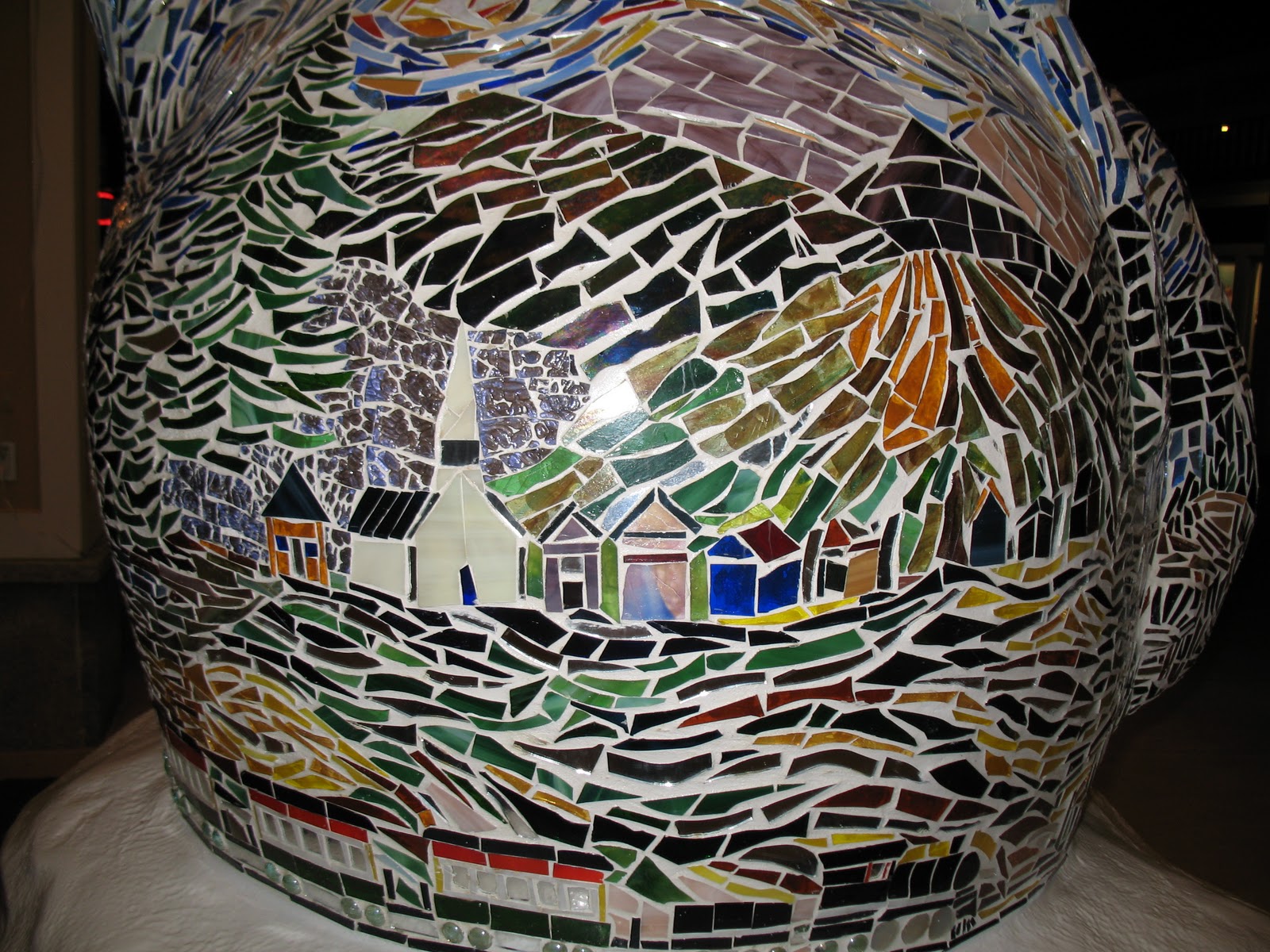
    My favorite snowman of all the snowmen on parade was inspired by my favorite expressionist and one of my favorite artists.

    Expressionism was given a distinctly local flare with images of New England style churches, homes, and covered bridges, which are a particularly valued part of New Hampshire heritage.

    This past weekend, I visited North Conway, New Hampshire with my family and was pleasantly greeted by the community's Snow People on Parade. We saw snowmen sculptures near our hotel, near local shops and restaurants. We found ourselves seeking them wherever we went, hoping to get pictures in front of them all. The snowmen added to the festive feel of the area.

    This small tourist center nestled in the heart of the White Mountains was made for Christmas. Snowcapped peaks helped us dream of a white Christmas that contrasted greatly with the brown we still have over much of New Hampshire. The art of the snowman is a clever way to emphasize this community's strengths while supporting the local creative economy. The town benefits from the beauty and charm of the winter artwork and the promotion of local identity as a winter destination. While visitors tend to flock toward the area in the summer for its shopping and outdoor activities, winter is usually reserved for the skiers who stay at the nearby mountain resorts. The presence of the snowmen adds a new dimension to my feelings about the place and will encourage me to return during this sleepy time of year.

    The snowmen reminded me of a public art display that I saw in Washington D.C. many years ago. In 2002, the city commissioned 100 elephants and 100 donkeys from local artists to display for public enjoyment. It was exciting when my husband and I found new sculptures and it filled me with pride to see my country displaying a piece of its identity in a lighthearted way.

    When I mentioned the snowmen on the phone to my mother, she told me about another public art event down her way in Florida. Bradenton holds a bi-annual Geckofest where local artists create their impressions of the adorable local creature that can be found throughout the region. Gecko art is displayed in local buildings and then auctioned off to raise money for county art organizations.

    Public art exhibits like these raise awareness of cultural identity and celebrate community pride. They can serve to highlight a particular aspect of a community that one wishes to promote. Public art exhibits can be a valuable outreach tool and increase interest in local art and heritage. Cultural institutions may want to consider collaborating with area artists to create unique displays that will benefit their own organization, their community, and their visitors.