Showing posts with label archival resources. Show all posts

Saturday, June 22, 2013

Educating Archives

This week's post is a follow up to April's High School Archives as Independent Study post. As a newly minted high school information specialist, I am seeking better ways to teach students an overall  understanding of information in all its forms so that they may become adept at understanding and using this information. Working in a school has been eye opening. In my opinion, there is a strong need for a more wholistic approach to the use of information among young people.

As a case in point I will discuss one student contact that I see as a success. I had my final meeting with my archives directed study student yesterday and await her final project. The student's goal was to create a timeline of the history of schools in our district. We went on a field trip together to the local historical society. We saw the collection they had related to local schools. The Society gave the student a slim volume that discussed the one room schoolhouses in town. She was off and running.

Over the course of the semester, the tenth grade student used the book she was given to pull out information about local schools with the intent of creating label copy for her timeline that will be exhibited in the library. She worked and reworked her words. She created a timeline covering 100 years of the school district with eventual clear intention that she would not cover up to the present day on the timeline itself.   She plans to credit the book and historical society at the bottom of her timeline. She visited the historical society for a second time on her own and chose photos to include in the exhibit. She went out and took her own photos of the buildings that are still standing.

The students' project morphed along the way. She began by reviewing high school yearbooks to better understand how our high school has evolved and changed; how the interests and activities of students have changed over the fifty years since our high school was built. After our visit to the historical society, she went on the trajectory described above. I think that's okay. I think it set a base for understanding that student life has changed. I think that looking at yearbooks started her thinking about the past and put her in a better frame of mind for imagining life further back. This project made me more firmly believe in the idea of teaching history backwards. I'll be interested to see if the student hands in something related to her yearbook findings on her own or if that aspect gets dropped altogether. It is okay either way.

I visited the local history collection at our public library earlier this week. I made copies of materials that supplemented what the student had found in the historical society's slim volume. Yesterday, I showed the student annual reports that included school committee reports. I also showed her other local history books that mention area schools. One of the larger volumes about our town has been scanned by Google, so I explained and showed her this too. [I do wish that I had done this earlier in the project. However, it may have just confused a student at this age. I need to reflect on this some more.]

Yesterday, when I asked the student what she has learned, she told me that she was surprised by the number of schools we have had in our district over the past 150 years. This is what I told her that I thought she learned:

  • How to create tight descriptive summaries and get rid of useless words
  • How to take someone else's words, study them carefully and extract their true meaning. To question what someone else writes. To understand that even something published is not an absolute authoritative information source.
  • To back up what a writer says by viewing other sources.
  • To seek archives (in this case the school reports) to back up conclusions.
  • The need to write papers (or exhibits) with a clear beginning and end - to not leave the reader "hanging" when writing something that is supposed to be informative. 
  • To state her intention and carry a project to the end, with room for self-discovery and creativity.
  • To reach out to experts (in this case the historical society) on her own for help.
More than the final product, the process of the work done to create an understanding of local history was successful here. What I hope the student gained, more than anything, is a passion for exploring her own interests and for learning. Only time will tell us that.

Sunday, October 14, 2012

The Diary Project Revealed

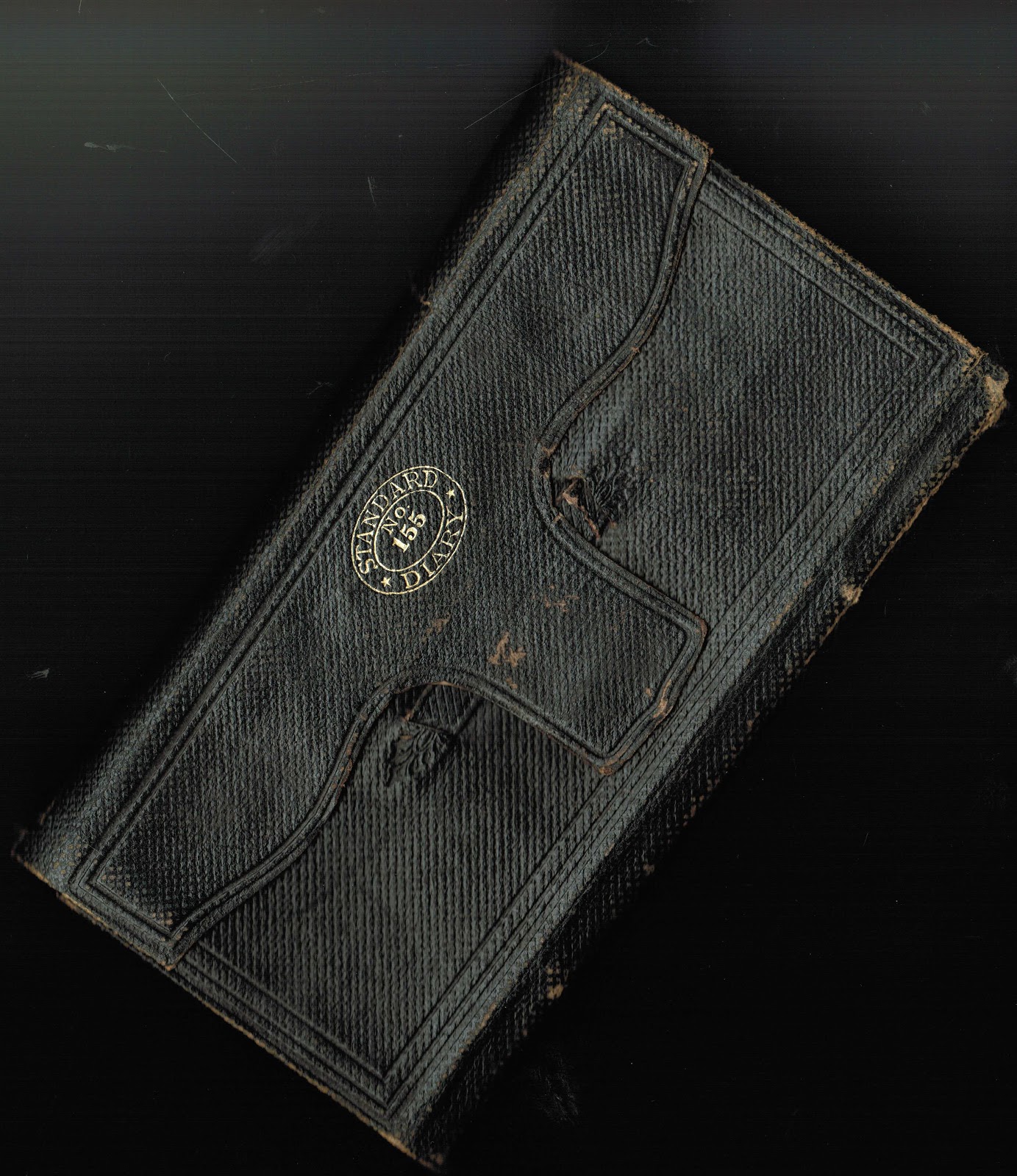
I found a diary in an antique shop in April 2011 and had a mission to discover its writer. To follow my research adventures, search "Diary Project" in the search box of this page.

January 8, 1882

"Today commenced very nicely, but commenced to cloud up about ten oclock, and rained a little in the afternoon and quite hard in the evening. I went to church this morning and played the organ. This afternoon I was married by Mr. Lyman Chase at the parsonage at half past ten in the afternoon..."

I was so confused. This short passage contained the only mention of a wedding - just one line. I thought that either my diary writer was using the word "married" in a way that I didn't understand. I thought that perhaps, 130 years later, the word "wedding" lost a certain connotation. Or, I thought, my diary writer was NOT a hopeless romantic.

It turned out to be the latter.

I found the record at the Historical Society. The "Marriages" book is arranged alphabetically, so I hunkered down for what I thought would be a long morning of browsing to find the date mentioned in the diary. I was lucky. The date revealed itself in a matter of minutes rather than hours.


Edward C. Miller was a prominent pharmacist. Leading Businessmen of Kennebunkport states, "...The rarity of the cases where any harm has come to customers on account of the ignorance or carelessness of Pharmacists, speaks volumes for the ability of those engaged in this line of business, and one of the best-conducted establishments of the kind in this section is that carried on by Mr. Edward C. Miller, here in Kennebunkport. This gentleman is a native of this place, and succeeded Mr. Brown in the ownership of his present store in 1881, it having been opened by Mr. Brown three years before...Especial and painstaking attention is paid to the quick and accurate compounding of prescriptions, and moderate charges are made in this most important department. Mr. Miller is connnected with both the Free Masons and the Odd Fellows, and is one of the best-known men in town."


My research has revealed much about the life of this gentleman, but there is a lot more work to be done. For my part, the diary transcript and research will be used as a tool to teach about primary sources, close reading, and more. I will leave the biographical, historical work to a historian. Someday, I will find a good home for the original diary - in a proper repository where it belongs.


Mr. Miller, thank you for coming into my life. I look forward to returning a piece of your memory to your community.


Thursday, May 17, 2012

The Diary Project Continues: Making Connections

Catch up on former Diary Project entries here: http://archivesinfo.blogspot.com/2012/04/mystery-solved-1882-diary-writer.html
***
The cemetery where my diary writer is buried. I now have a
stronger interest in the man who served as a town minister.
Did he officiate over any burials here?
I never made it to Maine over spring break to do diary research. The weather was iffy and time flew by with other things. Despite putting aside the diary for awhile, I do have some news. Recently I was contacted by a gentleman in New Jersey who has been researching the life of the minister who officiated at my diarist's wedding. The researcher came across my last blog post on how I found my diary writer. Based on what I said, he realized that the minister to whom I was referring was probably the one he was researching.

The Internet has opened up so many opportunities for researching and sharing information. Just a  few years ago, this researcher and I probably would have done our work totally separately without any opportunity to share information; without the opportunity to know that the other person existed. Here are some thoughts about this:

  • Blogging is great for tracking your life, sharing your views, sharing information and making connections. I've met so many people around the world through participating in social media. These people have influenced my thinking, my career, and my personal life.
  • Through the Internet, I have found information about my diarist and connected more easily with archives that have information to assist me.
  • I have been able to plan my trips to Maine to do research by using the Internet. I knew virtually nothing about Maine before this project. The Internet has allowed me to set a strategy for my work in a more organized way than I could do without it.
I think we all know the advantages of the Internet...but the value of visiting archives themselves and really making human connections to find information is illustrated by this project. During my last visit to Maine, I visited a repository and queried the assistant there to get information for my research. The repository lacked a finding aid and I needed to rely on the knowledge of the person who was helping me. I asked for church records thinking that marriages would be recorded there and was told that there were none. I needed to backtrack and rethink and re-frame the question. I made a list of other possible materials the archives might have. I asked for records or publications related to marriages in the town. Bingo! None of this information is on the Internet. As much as we would like to think that the Internet is the end all for all our information needs, it is not. In fact, few small repositories have the resources to connect their resources to the digital world. This repository still did not even have their materials "indexed" on paper.


The gentleman I spoke with on the phone has also done some digging for records in Maine. He told me that his minister lived in NJ, Maine, and California. That he always had health issues and seemed to keep moving in part because of these health issues. In addition to being a clergyman he also studied medicine. I suggested that my new friend query the Town Hall for records. In Massachusetts and New Hampshire, old church records fall under the jurisdiction of the Town Clerk when a church goes defunct or can no longer care for its archives. Perhaps he would find some mention of his man in the Town Hall vaults.

In case you're interested - Mass. General Laws Chapter 66 "Section 16. If a church, parish, religious society, monthly meeting of the people called Friends or Quakers, or any similar body of persons who have associated themselves together for holding religious meetings, shall cease for the term of two years to hold such meetings, the persons having the care of any records or registries of such body, or of any officers thereof, shall deliver all such records, except records essential to the control of any property or trust funds belonging to such body, to the custodian of a depository provided by the state organization of the particular denomination or to the clerk of the city or town where such body is situated and such clerk may certify copies thereof upon the payment of the fee as provided by clause (25) of section thirty-four of chapter two hundred and sixty-two. If any such body, the records or registries of which, or of any officers of which, have been so delivered, shall resume meetings under its former name or shall be legally incorporated, either alone or with a similar body, the clerk of such city or town or the custodian of said depository shall, upon written demand by a person duly authorized, deliver such records or registries to him if he shall in writing certify that to the best of his knowledge and belief said meetings are to be continued or such incorporation has been legally completed. The superior court shall have jurisdiction in equity to enforce this section." It is certainly worthwhile for any researchers to understand what records are held in public trust. There are often many records that reflect local citizens lives held by Towns. http://www.malegislature.gov/Laws/GeneralLaws/PartI/TitleX/Chapter66


So here's my thinking today... because my diarist was pharmacist and I now know that his minister was a doctor, I wonder if there connection goes beyond "business." They were both upstanding citizens of the community, considered in the higher echelons of Town life. I wonder if beyond the pulpit, perhaps the "hung out" together? Did they sip tea together? Professionally, did the doctor write any prescriptions that were filled by my pharmacist? I may never know the answers to these questions, but at least now I have another thread to pull.

I think that before summer arrives, I will write to my friends at the Maine State Archives to see if they have any information for me. I will then plan to make a visit this summer. My mentor, who originally worked as the archivist at the Portsmouth Public Library when I was a college student, is now at the Maine Archives. She and I have stayed connected, but we haven't seen each other in over a decade. It's time to catch up. Nancy, here I come!

Wednesday, April 11, 2012

Mystery Solved! 1882 Diary Writer Discovered

I like to frequent antique shops regularly because they're fun and because I am always on a mission to find sample materials for teaching about archives and cultural heritage. Last year I made my best antique shop find ever when I stumbled across a diary from 1882 that covers six months in someone's life. You can read about my early 1882 diary explorations here:

The Diary Project Begins
The Diary Project - First Stop. Biddeford, Maine
The Diary Project Continues - Kennebunk and Kennebunkport, Maine

I quickly realized that my diary was from Kennebunkport. I have taken my time and do research when I get an opportunity to do it. I've puttered on the Internet looking for information about the town and its 1882 inhabitants. Last week I made my third trip to Maine to do some research in local libraries and archives there. While on my previous two trips, I keyed in on names mentioned in the diary, so I knew with whom my diary writer was friendly. I was lucky in that my diary writer included first and last names of the individuals with whom he had contact. This time, I aimed to focus in on particular events that seemed pertinent to figuring out exactly who this person is.

I first intended to start my research with a minister who appears a few times in the diary. The diary even said that he married my diarist, but the recording of a marriage was so casual, that I thought I misunderstood "This afternoon I was married..." (If this indeed was a marriage in the sense I was thinking of it, I realized that this book was most assuredly written by a man because it was addressed so cavalierly. Surely a nineteenth century woman would have more to say about this occasion?  I had other clues indicating this was written by a man, including the purchase of an overcoat and the mention of running a shop, but I still was not positive of the gender.)

This is the only mention of a marriage in my 1882 diary: "This afternoon I was
married by Mr. Lyman Chase at the parsonage at half past two in the afternoon."

Unfortunately, the research center in Kennebunkport had no finding aids. I had to rely on the knowledge of the assistant helping me. With tables turned -- archivist as researcher -- this was exceptionally hard to do. I can appreciate researchers who want to explore our vaults despite our rules to the contrary. I was in a similar boat, but the lack of any sort of collection index was particularly frustrating.

As I asked questions about the minister, I quickly realized that this was perhaps the wrong tact. I shifted gears and asked if the Center had any marriage records. They did and the booklet recording nineteenth century marriages was arranged alphabetically, not by date. Preparing for a long morning of browsing names, I was pleasantly surprised to find what I was seeking within a matter of minutes. A record of a gentleman married to a woman named Nell was written with the date my diary casually mentions its writer being married. Nell is mentioned over and over again in my diary. I thought Nell was just a friend. Turns out she's my diarist's wife. (See? A man!)

Kennebunkport. My new research home away from home.
I am not quite ready to reveal who my diarist is, but I will say that he was well-known in Kennebunkport. The information about his life neatly unfolded before me. I found out where he was buried and visited his grave. I found out where he lived and visited his home, which is still standing. I found out where he worked and think that the building may still be standing, but I need to do more research on that. What remains for me is in the details. I know who this man was. I know that there is a lot of information out there about him. Some of the things I found in my diary I suspect will shed a little light on how things worked in town, or at the very least, will tie together some long lost stories.

Mystery remains about the exact location of the diary
writer's business
The diary includes mostly just a few sentences each day from January to June 1882, but they are sentences packed with relationships, activities, and news. My elementary school-aged daughter will continue to assist me on this project. I found this latest information without her by my side, but she will accompany me on a trip back to Maine over her spring vacation. I will show her the burial site, the house, and downtown where our diary friend worked. My daughter plans to draw photos of these sites. I am also helping her to pick one aspect of the diary or this gentleman that she can focus on for her own research. Perhaps she can learn about his children. Perhaps because this is a sea side town, she might want to explore something about the beach...I will leave it to her, but will help her make a list of possibilities.

Today I welcome a new member of my historical community. I never knew him and he would never have suspected that someone like me would take any interest in him one day. But here I am. Our legacies will be woven together in a historical timeline that often takes human stories to very unexpected places.

Perhaps the next big mystery is: How did this little diary end up in a small shop on Route 13 in northern Massachusetts? I've got a few ideas for figuring out its provenance, so stay tuned!

Tuesday, January 31, 2012

The Diary Project Continues - Kennebunk and Kennebunkport, Maine

Last spring I found a diary in an antique store. (You can read my early posts about it if you search for "diary" on this blog.) 

I needed to take a hiatus from traveling during the second half of last year, so I spent some time doing online research. My diary is from Maine and after a little deductive reasoning and research, I was able to determine that it is from the Kennebunkport area. I located nineteenth century newspapers and directories of Maine businesses that listed some of the names that I found in my diary. 

Today I did more research at the Kennebunk Public Library and briefly talked to the folks at the Kennebunkport Historical Society. I will make an appointment at the Historical Society during research hours because I think that is where I will find more of the information that I need. I am now as close to one-hundred percent certain that the writer of my diary is from that town as I can be without knowing who the actual writer is. The names I have been able to find so far were all Kennebunkport residents. 

The director of the Historical Society clued me in to a diary at the Kennebunk Library written by Andrew Walker, so I spent time with that today.

Local History section a the Kennebunk Library
Andrew Walker's diaries cover a good part of the 19th century. Like my diary writer, Walker was active in local politics and worked in a local shop. For a very brief moment, I thought perhaps my diary was written by him too. I have been carrying around a diary transcript and not the original. I had my husband take photos and text me pages in my diary to compare the handwriting to Walker's. They are not the same writing. After closer examination, I also realized that Walker's diary did include the first six months in 1882 that my diary covers, though the contents page of his transcript did not make this clear at first. I photocopied the pages from the overlapping dates and will review them to see similarities from the comfort of my living room. At a quick glance, I noticed that Walker covers the same train crash as my diarist. I want to see what other events overlap. Here I'll get insight on two different men in neighboring towns watching local events unfold. 

Some of the names in my diary were located in the index of the Walker diary. He sometimes recorded happenings in Kennebunkport as well as his own town. I checked off names that appeared in both indices. (I had made a name index of my diary as soon as I got it.)

From the diary of Andrew Walker (1808-1899)
I am not positive yet where this research work will take me, but my main purpose for this project is to show the value of personal records for revealing local history and communities. I now have a clear way to show how local records reveal overlapping communities in Kennebunk and Kennebunkport. My daughter is helping me with the project and a second layer to this is showing how such materials can help get children excited about history. I can't wait to share what I've found with her today!

***
Here are some interesting quotes from the Andrew Walker diary, which are recorded in the introduction to the diary transcript. It is worth noting that he had a clear idea of why he was writing this. I have written extensively in my blog about the value of keeping a diary. It is interesting to see how someone over 150 years ago had similar ideas...

January 1, 1851

"I Andrew Walker propose to write a short diary in this book of such events in this quiet village and vicinity as come to my knowledge. By the term events I include whatever may be suggested to my mind at the time of writing, whether of a private or public nature, my own thought or the thoughts of others. In short whatever may come uppermost, that I shall try to express. How long the diary may continue remains to be seen."

April 19, 1852   

"On the first of January 1851 I Andrew Walker, commenced a Diary and have continued it until the present time. The principal objects I had in view in keeping this diary were,...
"First, in order that I might by constant practice acquire a greater facility in expressing my thoughts on paper.
"Second, noting down many events in this vicinity that now seem of importance but will presently dwarf into mere littleness, other events now insignificant in our eyes, but one day will assume an an (sic) air of important magnitude.
"Third, the pleasure of information to be derived in subsequent years in knowing how events were considered at the time when they transpired and what my opinions were at that time. I recollect of reading somewhere, 'As a woman likes to view herself in a glass, so a man likes to see himself in his diary.'"


 Andrew Walker kept eleven volumes of diaries, covering the years 1808-1899.


Wednesday, January 11, 2012

Links to Helpful Archives and Cultural Heritage Web Sites

I've been collecting my Links to Helpful Archives and Cultural Heritage Web Sites for about 15 years now. They started as bookmarks for myself as I did research for library patrons, wrote client reports, and published articles. I then decided to put the links online to help others interested in good resources for archival work. The list grows as my interests do and as ideas in the field of archives management change and develop. Digital Collaboration is now the fastest growing topic on my page. Recently I have been collecting links on community studies for my own research and I think that may be my next new subject heading on the Links web page.

One day as I was updating the site, I decided to tweet about it. I think that may have been about a year ago.  I have received much positive feedback and numerous retweets. So, every time I now update the page I put out a tweet (or two or three) to say that I have done so. I'm glad that people seem to find this useful.

I thought I'd write this post to ask you about your own favorite archives related web sites. As the list stands now, it is very much a personal site. Everything included there I have admired and I have used the information to develop my own ideas about my work and its place in my field. When I started collecting links, there were few archives related web sites. Now there are too many for me to examine them all on my own. So, with that in mind, I hope that others will feel free to recommend sites that they find particularly useful for the promotion and care of archives and cultural heritage resources. If you think something is list worthy -- a site that you have created or one to which you frequently refer -- please comment here, shoot me an email or send a Twitter shout out. I can't wait to discover some new things! Thanks! - MM

Monday, March 7, 2011

Exploring the History of Women - More on Documenting the Underdocumented


Women's history is often elusive. Records of women's activities were limited up until the twentieth century. The documents that showed women's role in society were hard to come by or non-existent. Fewer women than men were well-educated or knew how to write. Fewer women participated in activities outside of the home that led to the creation of documentation for us to examine. Many women's traditional activities were not considered worthy of record.  March 2011 is the anniversary of Women's History Month in the U.S., providing us with the perfect opportunity to consider the documentation of my often under-documented sex. March 8th also marks the 100th anniversary of International Women's Day, which grew out of early twentieth century labor movements that sought comparable treatment for both sexes in the workplace. We now celebrate women's history to recognize the achievements (big and small) of all women around the globe. From cleaning the house to running major corporations, from raising children to winning competitions, the activities of women should be documented and appreciated as vital to our understanding of our communities and of a greater humanity.


According to American Libraries, "The roots of National Women’s History Month go back to “Women’s History Week,” first celebrated in Sonoma County, California, in 1978...The United Nations began celebrating International Women’s Day on March 8, 1975, during the U.N. International Women’s Year and encouraged member states to establish a similar day on a date appropriate to their traditions. Celebration of International Women’s Day has extended to over 60 nations..."


The following is a list of just a few of the wonderful online resources I've explored for archival material and documentation projects related to Women's history: 


Civil War Women: Primary Sources on the Internet by Duke University


Do History - Martha Ballard's Diary online


Georgia Women's Movement Oral History Project - (with a link to related oral histories throughout the United States)

Quilts as Women's Documents: The Louisiana Quilt Documentation Project

UNESCO Libraries Portal - sources for women's history


"The Library of Congress, National Archives and Records Administration, National Endowment for the Humanities, National Gallery of Art, National Park Service, Smithsonian Institution and United States Holocaust Memorial Museum join in paying tribute to the generations of women whose commitment to nature and the planet have proved invaluable to society."


Women Working 1800-1930 - Diaries, Memoirs and Journals. Harvard University, Schlesinger Library Radcliffe Institute

****

Over at the Life in Context Facebook page, we encourage you to post images and stories about the strong women in your life. Please browse on over and take part! Document the memories of the women who have influenced you.