Showing posts with label women. Show all posts

Friday, July 24, 2015

A Sturbridge Village Learning Experience

The girls enjoy some candy and fudge in front of a gift shop at Old Sturbridge Village
This week, I took my daughter and her friend to Old Sturbridge Village in Massachusetts. The Village is the largest living history museum in New England on over 200 acres of land. It recreates an 1830s New England community with over 40 structures that include a general store, mills, homes, barns,  workshops, a school,  and more. The girls accompanying me were twelve-years of age and are about to dive into American History this fall as seventh graders. Our little trip gave them a taste of some of what they will learn, but the main lesson for my daughter surprised me.

The girls were disappointed with the beds of straw, but were enamored with the cozy wallpapered bedrooms. The cramped quarters in the stagecoach made us appreciate my car even more. They liked some of the outfits, but were glad that they did not have to wear them on a hot date. They enjoyed the games, but were not happy that they would be spending so much time at the age of twelve doing chores instead of playing.

Early in the visit, my daughter asked if she could have been artist during this time. I explained that art was a profession for very, very few and those few would not be from a village like this. If you lived in a city you may be exposed to art as she knows it, but not really on a rural farm. You would not be able to afford art supplies. You would not have had the time to practice drawing. And so, my daughter's thoughts turned to, "What profession could I have had in the 1830s?"

I have talked to my daughter about how much life changed for women in the 20th century. I told her about how when I was a kid, I was told that I could not run a steeplechase race that I really wanted to compete in because I was not a boy. I told her how much it annoyed me that our physics teacher often made points about physics by throwing baseballs to the boys in the class and not the girls. I told her about how grandma was turned away from her school entrance because she wore pants on a snowy day, even though she had a skirt in her bag for changing in the bathroom. But these are stories. These were my stories. Sturbridge Village helped us turn these stories into part of my daughter's own narrative when she was better able to apply what I've told her to herself.

The female interpreters in Sturbridge were sewing, caring for animals, baking and caring for the gardens. My daughter, who is an avid writer, wanted to visit the print shop. The girls hung back and I asked a lot of questions (trying to be a good role model.) "How did they make paper?... What was the ink made out of?" As we left, my daughter asked me if women could do that work. "I don't know" (Yes, I did.) "Let's go back and ask."
Her face grew grim at the negative response we received from the interpreter. Women may have done a little typesetting to supplement the family income, but that would have been rare and it would not have truly been a job. Women worked in the home.

My daughter walked through the houses with new eyes. Early in our trip, she mentioned how she liked the parlors and that she would spend most of her time there drawing. Now, she looked at the kitchens. She had no interest in the rooms for sitting and sewing. "I could spend my time in the kitchen. This room is open. I think I could do my chores here [and be comfortable and happy.]

When the girls saw the school house, they decided to be teachers.  "We could have done this!" they yelled as they ran toward the door. "You can pretend your the teacher now. I'll be the student." "I'll teach you spanish!"

The schoolhouse was actually moved from a town near us in New Hampshire, so I mentioned that fact hoping it would help the girls even better place themselves in the past. They ran into the building and were greeted by an interpreter who was standing at the teacher's podium. We took seats on the benches. Asking questions, we learned that the kids of Sturbridge attended school in summer and winter. They learned on their own at their own pace, from their own books. The teacher tested them on their lessons, but did not "teach" as we know it today. Teachers were young people who probably had just finished their own schooling. Adults did not teach. Young ladies would have taught in the summertime, if they had the opportunity to do so. They may have taught one summer session and that would be it. Teaching was not a "career."

The thought that my daughter would not have had choices in the early nineteenth century was eye opening for her. At various times during the day she talked about running away to the city. She learned she would likely then work in a mill. (Not appealing.) She imagined hiding in the fields so she could have some alone time for a day. I told her that she would not have even considered this. She would have been raised differently from the start and this would just be the only way of life she knew. She similarly said that she would have been terrible at sewing. I told her that if I started her off sewing at the age of four that she would have been just fine at it.

Our visit to Sturbridge made the experience of nineteenth century American life come to life for the girls. My daughter in particular will never see her place in the world quite the same way again. Furthermore, this fall the kids will be able to look back on our trip to give them better context and understanding for all of their American History lessons. I think now they will be able to imagine themselves in the full narrative of our country's roots and with an understanding that as girls, their opportunities would have been greatly limited from the full scope of what they learn.

Sunday, March 16, 2014

Women's History Month

Women's History Month prompts us to celebrate the women in our archives. In the past, documentation about women was elusive. Today, archivists are aware of the need to fill gaps in the story of women and we are working to remedy the loss of information about women in history as much as we are able. We are continually finding more materials in our communities. Our goal, as with all archives collection development, is to flesh out and create as accurate an account of women's role in society as possible.

We have not been the only underrepresented group in American archives: people of different ethnic backgrounds, the poor and middle classes, people of different religions all fall into this category. Archivists are aware of this. Yet, as a woman, I have felt particularly attached to the "women's issue." Why did parents hope for male children? Why was I not allowed to compete in a sport that was labeled as just for the boys? Why was reading a historical book about someone named Molly or Clara unusual during my childhood, while names like George,  John, Benjamin and Martin were pervasive? I have thought about these things for as long as I can remember.

A few years ago, I began collecting orphan photos in antique shops. At first I was attached to the costume, faces, and settings. I wondered about the stories. I wondered about the occasion upon which the photos were taken. I wondered about the personalities of the people. Pretty soon, most of my collecting started leaning toward images of women. I wondered about the relationships between wives and husbands, mothers and sons, mothers and daughters, sisters, classmates...Collecting images of women reminded me of the own strong women in my life and helped shed a light on my own relationships.

Archives have a role to play in boosting personal pride. My photos of women are one way I am reminded of my connection to the past - to something bigger than myself. The things I think and do today are grounded by the people who helped build civilization before me. What I do today will help grow the roots and ground my daughter and her daughters (and sons) to something bigger. We keep moving forward, but we are never alone.

Earlier this week, an English teacher in my school brought in an album of images that he collects. Most of the images were of men with beards. My colleague does not have a beard, but it was interesting that he chose these hairy gentleman for his focus...I'll have to ask him if his father had a beard. I found the beards interesting. In fact, images of bearded men remind me of a painting in my living room growing up. The painting was of a rabbi that my mom said reminded her of her grandfather. But the attachment that I have to those visuals is more of curiosity. It does not feel as immediate or intimate to me. Theirs is a related story, but (for better or for worse) it is not entwined so deeply with my own.

Each of us can find something inspiring in history that helps inform our own lives. This post contains some of the photos in my collection to which I am most attached: Women who remind me of my neighbors and my mother; Women who could have been my ancestors; Girls with curls; teenagers with obvious angst (yes, these remind me of me too);  young women who remind me of myself during happy and calm times. The struggles, happiness, and education of women found in these images fills me with pride and understanding.

And yet, within each image is also a story of those not shown. We women form a very large community. The community of men stands beside us and overlaps us. So while women's history is noteworthy, it does not forget the rest of humanity.

Men and Women: A Shared History. Women's History Month


Happy women's history month. May you too find inspiration and connection to our shared history.


Monday, November 26, 2012

Herstory Project Podcast: Ida Annah Ryan

I was honored to be a participant in the Chick History Herstory project. Hear my podcast about Ida Annah Ryan, native of Waltham, Massachusetts, suffragette, and one of the first female architects in the United States.


52 women. One year of history. #HerStory is a project for 2012 in which each week, a contemporary woman shares the story of a historical woman who inspires her.

Tuesday, July 5, 2011

More Finds at the Local Antique Shop - More Romanticism of the Female Portrait Photograph

Last night I was watching the show American Pickers and was struck by a photo. The episode called "Danielle Goes Picking," which originally aired on the History Channel in December 2010, included the find of a portrait photo of a beautiful woman. Regular readers of this blog know the hold that these types of photos have over me. My photo find to the left is an example of a similar type of image to the one that appeared on the show. Like me, the pickers "oohed" and "aahed" over the image. I am on a mission to put into words why these images capture us and I hope that you have some input into the matter to add to the comment section.

In general, I prefer the caught in the moment action image. I like the informal glimpse into the life of the photographed as if they don't know that they are being caught on film. I like the idea of catching "A Life in Context" and I think that this is generally best done in snapshot type photos. However, there is something about the image of a woman dressed in her finery that I find alluring. It pulls my imagination back into another time and place faster than most other types of images. Posed in sumptuous dress with attention given to her setting, whether a Victorian, flapper, or 40s belle, the subject of a formal portrait like the one to the left is highly feminine and nationalistic.

Dress, hairstyle, pose, and environment are staged by the photographer to make these women look their best. Soft focus and carefully crafted lighting also helps to create a mood based in a bygone era. The women of these portraits are an American (or Western) ideal that is perhaps best expressed through the art of photography. These portraits show a "feminine" quality that promotes an envisaged view of the perfect woman. The women of these portraits display a dreamy quality. They can be said to reflect what many women want to be and the qualities that many men want their partners to have. They display a comfortable lifestyle and contentedness that we wish for ourselves and our fellow citizens. The prevalence of these images reflects the role of the female experience in shaping society and in developing our sense of history. They provide both insight into a woman's sense of personal identity, while also showing the context and collective molding of a national identity. This picture is what it means to be a successful American to many, many people.

Yes, I realize this is a narrow and somewhat flawed view of our society, leaving big gaping holes for stereotypes, chauvinism and other negatives to leak through. I realize that there are many potential arguments against idealizing this kind of display of wealth and this sort of objectification of women. The allure of the idea that we might all be able to get closer to this world of "perfection" by identifying with a portrait is at least in part fantasy, but I think it hits a sentimental button much like the Disney princess phenomenon. There are good points and bad points to the stereotype, yet there is still an attraction to it.

Nonetheless, I love these images for their beauty and sentimentalism despite any negative connotations that can be conjured from them. In the context of American life, these images tell a lot about our values and our history as a community. They tie themselves to an American dream that is evident in other forms of visual arts from the late nineteenth, early twentieth century period and in our literature from those times. As "orphan" photographs, these posed images ground the unidentified woman in a culture that forms a large piece of the American narrative. As items from the world of archives, they document the lives our foremothers led and reflect an image toward which we have been taught to strive.

***

Looking for more about women in portraiture? please see

More Finds at the Local Antique Shop: The Profile Image in Context


Interested in more images of women? Here are a few great resources from archival repositories:

Harvard University Library Open Collections Program Women Working 
Library of Congress Women's History Picture Pathfinder
Women's History Photos on Flickr from the Smithsonian
Brooklyn Public Library Women's History Photo Gallery

Tuesday, June 14, 2011

Professional Until the End: Neighbors Never Knew Quiet Woman was a WWII SPY - Guest post by Rebecca Price

Periodically on the ArchivesInfo blog I post articles by guest bloggers. In the past, Linda Norris, Sarah Brophy, and Greg Lawrence kindly shared their thoughts on these pages. In an effort to promote one of ArchivesInfo's strongest goals, to  "encourage collaboration to ensure the security of a wide-range of cultural heritage resources," I feature writers who specialize in diverse aspects of cultural heritage. This month, I offer to you the writing of Rebecca Price, who runs the fabulous Chick History blog. Rebecca chose this piece about a WWII spy to share with my readers. Originally posted on the Chick History blog on November 11, 2010, the post discusses the role archives played in highlighting the fascinating legacy of one fearless female spy. Thank you Rebecca for sharing!

***

Professional Until the End: Neighbors Never Knew Quiet Woman was a WWII SPY

Secret Agent Woman
In September this year, Eileen Nearne died of a heart attack in her Torquay flat in the county of Devon, England. When officials cleaned out her apartment and were searching for contact information for her next of kin to arrange the funeral, they found instead medals, papers, and an extraordinary life. Eileen Mary Nearne, a.k.a. Jacqueline Duterte, a.k.a Alice Wood, a.k.a Rose, was a spy for the British army during WWII who worked behind enemy lines in Paris and was captured by the Germans in 1944.

Eileen was born in 1921 in London. Her father was British and her mother French. In 1923, the family moved to France where she lived until WWII broke out. When France became occupied by Germany, Eileen and her sister obtained British passports and moved back to England in 1942, leaving their family behind. They applied for work at the British Special Operations Executive (SOE). Because they were native French speakers, they were recruited for undercover work and were trained in wireless techniques. The plan was to receive messages in the field and then code, transmit, and destroy said messages.


In March 1944, Eileen was flown into Indre, France for her assignment. For the next four months she coded and transmitted over 100 messages in German-occupied France back to England. The majority of her transmissions were instructions and arrangements for weapon shipments into France for the resistance movement in and around Paris. In July, she was detected and arrested by the German Gestapo – the secret police of Nazi Germany. She was interrogated and tortured using water torture, but gave up absolutely no information on her real identity. She convinced the Gestapo her name was Madamoiselle du Tort and that she had no idea that the businessman she was “working” for was actually British. She was sent to a concentration camp and later transferred to a labor camp. During these ten months of imprisonment she was tortured, threatened at gunpoint, and her head was shaven.

In April 1945 she was transferred again, and this time she escaped with two other French girls into the woods. She evaded SS Officers once again, insisting she was a French volunteer, and stayed on the run for two weeks staying in abandoned homes and churches. When the American troops rolled in, she ran to them for assistance. Alas, they didn’t believe her story either, and kept her in a camp for the month of May until a British officer arrived and confirmed her identity and repatriated her. Yeah, she’s with us.

I'd like to take this moment and point out that Eileen was 23 years old at this time.

Images of the codes Eileen was responsible
for transmitting back and forth between
London and Paris. These, among other
fascinating material, were made available
by the United Kingdom National Archives 
in October after Eileen's death.
Not much of her life after service is known publicly. Later interviews indicate she missed her days working as a patriot for her country and found civilian life unsatisfying. She participated in a documentary on British Spies for the BBC in the 1990s, but she remained in disguise, speaking French, and using her code name Rose. A clip from the interview shows her in a wig recounting her capture and escape. I mean, once a spy, always a spy.

After her death, the British National Archives released the papers they had on her, which include photographs, newspaper articles, letters, and first-hand accounts of her training, services, arrest and escape. You can download these for free at the National Archives website.

These primary sources from the 1940s offer an incredible window into the time period and views of women about their service and capabilities. They also tend to reveal more about the person doing the describing than they do about the person being described.

A male Major assessing her training described her "as very 'feminine' and immature; she seems to lack all experience of the world and would probably be easily influenced by others. It is doubtful whether this student is suitable for employment in any capacity on account of her lack of experience." Two months later she was deployed to France.

The American officer who couldn’t see a trained British spy gave the following thoughtful conclusion: "Subject creates a very unbalanced impression. She often is unable to answer the simplest questions, as though she were impersonating someone else." In her version of the interview, Eileen Nearne states she withheld information to American officers because she didn’t want to give too much away. She was, after all, working for the British on convert military operations.

My favorite is the glowing recommendation SOE Officer Vera Atkins gives her when trying to find her a civilian job after ten months in a German concentration camp. “She is completely untrained, but she is extraordinarily reliable and thorough in any job on which she is keen.” This was a letter to a beauty salon.

If by “extraordinarily reliable and thorough” you mean able to code and transmit sensitive military operations, withstand torture and imprisonment in a Nazi concentration camp, and escape and invade capture in the woods, then YES, she is qualified to be a beautician.

After her return, she was recommended for and received two military honors, the Member of the Order of the British Empire and the French Croix de Guerre. Once her true identity was discovered after her death, she received a full military funeral with honors. Hundreds attended to pay respects.

Monday, June 6, 2011

More Finds at the Local Antique Shop - What's Old is New


One of the most wonderful things about archives is their ability to connect the past to the present. Consider this nineteenth century postcard of two women sharing letters. As soon as I saw it, I thought of my best girlfriends. They are the women who are always there for me and who love me for who I am no matter what. They are the ones who always make me feel comfortable and at ease. They are the people with whom I share a laugh and who can make me happy even when I am in a terrible mood. Women's relationships have not changed all that much, have they?

This image reminds me of passing letters back and forth to high school pals, giggling over confessed secrets and prizing an unspoken understanding between us. I feel as if  these women and I are part of some exclusive historical club of female bonding that is only separated by time. I was pleased to turn over the card to see written in pencil "my girlfriends May Doyle and Inez, Rose - Pearl Brown." Attaching names to faces, even if it never brings me more information than that, gives me another connection to these sisters from the past.

Lately, I have been talking a lot about communities as my colleague Sue West and I grow our "Life in Context" program. In addition to my connections to my girlfriends and to these women of the past, there is another connection at work with this image. I bought this postcard from an online site. I am a regular buyer here on this site, so I feel a community connection to it. Another thing I get out of this postcard is a connection to the particular woman who packaged it. She always packages my purchases carefully, includes a nice handwritten note, and puts a few "freebie" images inside the envelope for me. When I open the envelope, I get a whiff of a pleasant floral fragrance that reminds me of my grandmother. I wonder if the woman's house smells like this scent or if she specifically spritzes items that leave her possession as a little extra something special (This is not good from a preservation standpoint, but lovely from an old-fashioned, reminiscing, making something more personal standpoint.)

Archives have the ability to make us feel part of things larger than ourselves. I wish that I could meet these women, but I already feel as if I know them.

Monday, March 7, 2011

Exploring the History of Women - More on Documenting the Underdocumented


Women's history is often elusive. Records of women's activities were limited up until the twentieth century. The documents that showed women's role in society were hard to come by or non-existent. Fewer women than men were well-educated or knew how to write. Fewer women participated in activities outside of the home that led to the creation of documentation for us to examine. Many women's traditional activities were not considered worthy of record.  March 2011 is the anniversary of Women's History Month in the U.S., providing us with the perfect opportunity to consider the documentation of my often under-documented sex. March 8th also marks the 100th anniversary of International Women's Day, which grew out of early twentieth century labor movements that sought comparable treatment for both sexes in the workplace. We now celebrate women's history to recognize the achievements (big and small) of all women around the globe. From cleaning the house to running major corporations, from raising children to winning competitions, the activities of women should be documented and appreciated as vital to our understanding of our communities and of a greater humanity.


According to American Libraries, "The roots of National Women’s History Month go back to “Women’s History Week,” first celebrated in Sonoma County, California, in 1978...The United Nations began celebrating International Women’s Day on March 8, 1975, during the U.N. International Women’s Year and encouraged member states to establish a similar day on a date appropriate to their traditions. Celebration of International Women’s Day has extended to over 60 nations..."


The following is a list of just a few of the wonderful online resources I've explored for archival material and documentation projects related to Women's history: 


Civil War Women: Primary Sources on the Internet by Duke University


Do History - Martha Ballard's Diary online


Georgia Women's Movement Oral History Project - (with a link to related oral histories throughout the United States)

Quilts as Women's Documents: The Louisiana Quilt Documentation Project

UNESCO Libraries Portal - sources for women's history


"The Library of Congress, National Archives and Records Administration, National Endowment for the Humanities, National Gallery of Art, National Park Service, Smithsonian Institution and United States Holocaust Memorial Museum join in paying tribute to the generations of women whose commitment to nature and the planet have proved invaluable to society."


Women Working 1800-1930 - Diaries, Memoirs and Journals. Harvard University, Schlesinger Library Radcliffe Institute

****

Over at the Life in Context Facebook page, we encourage you to post images and stories about the strong women in your life. Please browse on over and take part! Document the memories of the women who have influenced you.

Tuesday, January 25, 2011

More Finds at the Local Antique Shop: The Profile Image in Context

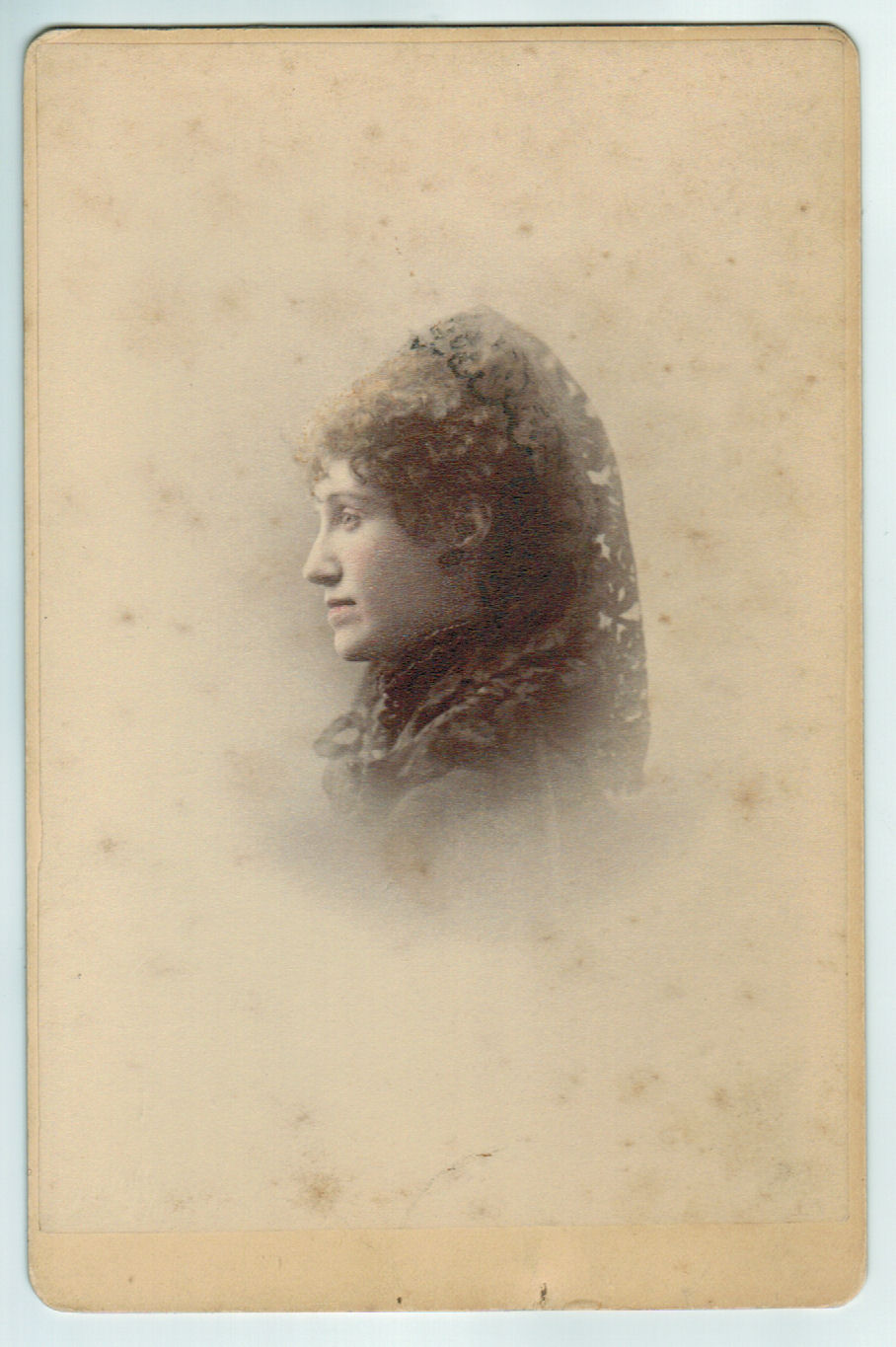
 While at the antique shop today, I found a few lovely profile images of women from the turn of the century. This is a pose that we rarely see in portraiture today and I began wondering about the history of it. I found Patricia Simon's fascinating web site with excerpts from her article "Women in Frames" that offers an interesting theory about the origin of women in this pose. Prior to the Renaissance, according to Simon, profile portraiture was reserved for men. Perhaps, I think because prior to this time, few women were considered to be important enough to have their visage preserved in high art (or any other art for that matter.) A few articles I've read have said that the profile grew out of classical imagery, as seen on Roman coins.  Men with prominent noses and strong jawlines, by the mid-15th century, were replaced by women in profile.

And here is where it gets most interesting for me...Simon theorizes that this format enhanced the idea of women as objects of beauty. They were shown with accepted modesty, including eyes looking away from the viewer and sometimes downcast. Simon claims that this pose also allowed Renaissance women to show off their finery without abashment, showing them as fine representatives of high culture and role models for their sex. This style was used to the same effect in the Victorian era, but can you picture Isabella Stewart Gardner accepting that kind of treatment? Consider the way she stares at you in her well-known painted image by John Singer Sargent -- almost daring you to make a comment about her femininity that she so proudly displays with her plunging neckline and tight bodice. This dichotomy in imagery reveals the struggle for women to gain equal footing with men. This is  evidenced in their historical fight for suffrage and equal rights, which  rose to prominence in the late nineteenth and early twentieth centuries, when my two antique shop portraits were taken.

By the time the camera came around, it seems that the profile was just one of the standard poses in a photographer's arsenal. In addition to the profile, I found a frontal view of the woman in lace. Yet the profile pose of the woman (and also of the girl below) are particularly striking. They appear almost porcelain-like. Their fine features are emphasized by this view from the side that also shows off the classic curls in their hair. They are virtuous female Victorians, perhaps stereotyped as such in these images.

I wonder why profiles are not popular today, but I have a theory. When someone happens to capture my image in profile, I tend to dislike it. I do not picture myself as my profile. I want to stare at the world head on. I want the viewer to recognize me and to see into my eyes. I want to appear strong and friendly. I do not want to be shrinking, lost or untouchable - like porcelain. Has modernity chased away a women's soft decorum and is this represented in our imagery? Profile images invite us to consider the context in which they were taken. Twenty first century images represent and document the modern woman and not the ideal woman of more than a century ago. Images such as these can give us remarkable insight into changes in our society and even a pose can tell us quite a bit.


Tuesday, April 13, 2010

Documenting the Underdocumented


I sit down to breakfast every morning with my computer in front of me to catch up on the archives news. (That is, I do that when I am not in the middle of a good book, which I am at the moment -- two in fact -- so it was a struggle to tear myself away. I was behind on my news reading though, so it had to be done...) This morning, three news stories in a row focused on women, so it seemed like the universe was telling me something. After chewing that for a couple of minutes, I began to think about my college advisor (about whom I recently wrote when I blogged about diaries) and her focus on women's studies. I was very influenced by her ideas. The realization of a separate women's history was profound after never having considered in my late teens that women could be addressed separately and differently and then having it weaved throughout my curriculum of studies. These considerations have thus influenced my whole career. I always keep the idea in the back of my head that people can be written out of history just because of their "station" in life. I hope that I can put this same idea into every archivist's brain, so that we are always striving to give a well-balanced view of history that goes beyond the cliched "rich, dead, white men."

My three women's news stories today were about Helen Keller, Jane Austen and Riot Grrrl. Helen Keller was famous in her lifetime for her remarkable achievements and though (as I remember it from a recent biography) she died nearly penniless, people valued her memory enough that her personal papers were likely to be valued. Jane Austen on the other hand, according to the article about an exhibition featuring her archives, died unappreciated and unknown. Finally, the late twentieth century feminist rock movement Rebel Grrrl possesses a cult following that is well-known is many circles, but remains unknown to many more.

The fact that so many different types of women are now represented in archives is gratifying, yet I wonder about the many who are not. This morning on BBC radio, I heard a report about Pakistani women subject to acid attacks. (I did tell you that the universe was pointing me in this direction this morning, didn't I?) Are their experiences preserved in a proper archival repository? How many nameless everyday people with stories that are vital to the understanding of humanity are left out of our archives?

Though my post focuses on women, my sex is only representative of many who have been under-represented in the past -- the poor, the homeless, minorities, working-people (such as the miners in West Virginia we've heard so much about this week.) As archivists, we have a professional responsibility to strive to make sure we collect multiple stories from multiple angles. Since the mid-twentieth century, the idea of social history has encouraged researchers to study the "common man." How well are archival repositories keeping up with the need to include diversity among our holdings? How do we make it a priority? How do we make sure its importance is emphasized and runs as a common thread through all the work we do? Whether you are working with paper archives or in a digital environment, your records need to reflect a whole human populace, from those who are very visible to those whose records are a little harder to find to those who have not created written records at all. And though all professional archivists encounter this idea in our training, I am not sure that we all cling to it in our practice. Please prove me wrong.
***

PS The Helen Keller book mentioned in this article is a wonderful read! It also uses many of Keller's personal papers to illustrate her life, making it more gratifying to a professional archivist

PPS The photo in this post is courtesy of the Albert Ryan II collection, Waltham Public Library, Waltham Massachusetts. A sign pictured in the photo states "Women vote in 29 states. Why not Mass?" Ida Annah Ryan, one of the master minds behind the sign, was active in the suffrage movement and was the first woman to receive a master's in her field from MIT. She went on to become a well-known architect.