Showing posts with label maine. Show all posts

Saturday, September 21, 2013

Teaching Archives: Reprising the Diary Project

Lesson Learned. Hopes confirmed. Teens are fascinated by archives.
How could they not be? We should have known this all along!

Last week in this space, I introduced a course I was preparing to teach at the high school where I serve as an information specialist. Over the course of the week, the twelve classes I taught on Introduction to Information began to morph. What started out as a very formally laid out series of ideas melted into a few very big ones. Information is everywhere. We need to pay attention to details. We need to pay attention to what we know versus what we think we know to distinguish truth from fiction - to build our knowledge and to properly educate ourselves.

All freshmen English students took a test on evaluating information during the first half of one of their English periods this week. My lesson on what information REALLY is took place during the second half of the period. My goal was to give them a broad understanding of information and to show them that information does not have to be as dry as a test. I had objects for show and tell that I wove into the presentation. I had a stereoscope, photographs, war ration coupons, a primer. One class, on the second or third day of teaching, had split up. About half the class was still testing while the other half sat patiently in the chair waiting for the lesson. I pulled out the stereoscope. This was not part of the original plan.

"Let's have a little show and tell before the rest of the class gets here. Has anyone ever seen one of these?" There was an immediate buzz and we began talking about the Viewmasters we had as children. I passed around the stereoscope for the students to get a closer look. The remaining test-takers started to trickle over.

"Has anyone ever gotten stickers from their teachers for doing good work in school?" Hands fly up in the air. "Well before there were stickers, students got 'Rewards of merit,' like these. Students valued them so much that they would stick them in scrapbooks. You can see the remnants of the scrapbook on the back of these cards." Pass them around. And so we went on...I had planned to start my presentation with a photo from Ransom Riggs' book, Miss Peregrine's Home for Peculiar Children, but the archival materials proved to be a better warm up.

At the end of this lesson, the 5th one this year, a teacher said something profound to me. It was my second class with this teacher this autumn. I had worked with her rather closely last year designing a research curriculum for ninth graders and I greatly value her teaching expertise. She said, "Melissa, that was your best information presentation yet. You don't need to teach them everything in this lesson. You just need to get them interested."

Parts where I had picked up steam earlier in the week -- evaluating photos, viewing letters and diaries -- those related to archives, stayed in my presentation. Parts where I found I had lost steam were removed. "What does the word 'information' mean? What's an information resource?"

Show and tell led to discussing photographs. I kept Ransom Riggs' images as fodder. Here's an example of one we discussed.
photo from "Miss Peregrine's Home for Peculiar Children"
Me: "What do you see here?"
A moment of quiet.
Students: "OHHHH! There's one girl and two reflections! Maybe that's her dead sister! Maybe its her alter ago..."
Me: "Wait. Back up. First tell me what you actually see. One girl. Two reflections. What else?"
Them: "Gravestones... Water... One tall gravestone one short...oh! creepy! the short one isn't reflecting!"
Me: "Ok. Use knowledge you already have. Information in your head...why is the short one not reflecting?"
Blank stares and then someone says, "It's too short."
Me: "How do you know that? AHA! We need to have some understanding of math to know that don't we?"

Nearly every class had the same conversation with the same elements of the photo pointed out to me.

Me: "Now tell me based on your knowledge of the real world, what is happening here? Why are there two reflections?" We talked about double exposure and darkrooms and light sources.
"Now, let's do what Riggs' did and jump out of reality and make up a story. Now we can go back to our ideas about alter egos and dead sisters."

The exercise in which I had them close their eyes to picture a library memory (see last week's post) became close your eyes and picture a place that you love. "Picture an amusement park or a ball game. What sights and sounds and smells were there? Take in the information with all of your senses. Pay attention to details." It's the details that mattered and the information. Not the library setting. One can get a "sense of place" anywhere.

We went through many photos analyzing each. This included Riggs' photos and photos that I had collected at local antique shops. [Search "More Finds at the Local Antique Shop in this blog for samples of my collecting.] Then, I pulled out the diary.

I explained the research that I did with my daughter.
Me: "I found this diary in an antique shop in Massachusetts. I wanted to learn who wrote it."...
"On page 2 it talks about a train crash near Wells and Kennebunk. Where do you think this diary was written? [silence] What state?"
Students: "MAINE!"
Me: "I don't know why, but the author wrote first and last names of friends. I don't know about you, but when I write in my diary I write first names only. Maybe first and last names was common diary writing then. I could research that if I wanted to, but that's not the direction I wanted to head. How can I find out more about these people with their first and last names as information at my fingertips?"
Students: "GOOGLE IT!"
Me: "Yep, that's what I did and on books.google.com, I found their names in a book called "Businessmen of Maine....Do you know about books.google.com?...that's all I found on the Internet. Where should I go now?"
Students: [some confusion and then usually a tentative...] "Go to Maine?"
Me: "YES! Where am I going in Maine?"
Students: "To the library!"
Me: "What library?...what am I looking up at the library?" and so I revealed the clues. Then I revealed a dead end. I knew all about the people and places surrounding my diarist, but I didn't know my diarist so I re-read the diary. A clue that I had originally ignored stuck out. I told the students that the diarist mentioned a marriage on a particular date, but I had ignored it because it was mentioned so matter-of-factly that I thought I misunderstood. This time through, I decided to pursue it as if the person was really married on that date. Sometimes we don't see what's right in front of us. Instead of throwing up our hands and saying "There's no information!" sometimes we need to slow down and re-evaluate.
Me:"Where do I go to find out about marriages?"
Student smirking: "The Internet!"
Me smirking back: "NO! Where do I go? (quiet) If your parents were married, what document says that they were married?"
Student tentatively: "A Marriage certificate."

Early in the presentation, I showed students places I had worked to shatter their ideas about what the "information sciences" entails. I have had such a varied and unusual career that when I was putting together my presentation this seemed like a worthwhile thing to highlight. However, my discussion of my own career became more important with this line of thought. I had shown students a picture of a town hall vault and explained that important town records were kept there.

Student: "You would go to town hall to find a marriage certificate..."

The pieces came together. They were getting the idea about following an information trail. I revealed who my diary writer was and showed pictures of him, his house, his business, his marriage record. I showed an advertisement for his business and the plot map for his grave.

After one class, a teacher told me that a student had leaned over to her to whisper that the fact that I had visited his grave was really cool.

At the end, we talked about different ways of learning and creating a makerspace in our library. We talked about behavioral expectations. We talked about books. They were paying attention. I felt like I was getting to know them as a class. (I am excited about the school year now!)

Moral: Wherever you are evaluating information, the rules of slowing down and thinking about what is going on applies. I think this is the most important thing my students learned from me this week. Information is everywhere and we need to pay attention to appreciate it. Oh yeah, and archives are cool!

The ins and outs of finding out more will come throughout their high school careers.

If any students are reading this, thanks for a great week! I look forward to learning more with you. Thanks for teaching ME about what is important.

Thursday, May 17, 2012

The Diary Project Continues: Making Connections

Catch up on former Diary Project entries here: http://archivesinfo.blogspot.com/2012/04/mystery-solved-1882-diary-writer.html
***
The cemetery where my diary writer is buried. I now have a
stronger interest in the man who served as a town minister.
Did he officiate over any burials here?
I never made it to Maine over spring break to do diary research. The weather was iffy and time flew by with other things. Despite putting aside the diary for awhile, I do have some news. Recently I was contacted by a gentleman in New Jersey who has been researching the life of the minister who officiated at my diarist's wedding. The researcher came across my last blog post on how I found my diary writer. Based on what I said, he realized that the minister to whom I was referring was probably the one he was researching.

The Internet has opened up so many opportunities for researching and sharing information. Just a  few years ago, this researcher and I probably would have done our work totally separately without any opportunity to share information; without the opportunity to know that the other person existed. Here are some thoughts about this:

  • Blogging is great for tracking your life, sharing your views, sharing information and making connections. I've met so many people around the world through participating in social media. These people have influenced my thinking, my career, and my personal life.
  • Through the Internet, I have found information about my diarist and connected more easily with archives that have information to assist me.
  • I have been able to plan my trips to Maine to do research by using the Internet. I knew virtually nothing about Maine before this project. The Internet has allowed me to set a strategy for my work in a more organized way than I could do without it.
I think we all know the advantages of the Internet...but the value of visiting archives themselves and really making human connections to find information is illustrated by this project. During my last visit to Maine, I visited a repository and queried the assistant there to get information for my research. The repository lacked a finding aid and I needed to rely on the knowledge of the person who was helping me. I asked for church records thinking that marriages would be recorded there and was told that there were none. I needed to backtrack and rethink and re-frame the question. I made a list of other possible materials the archives might have. I asked for records or publications related to marriages in the town. Bingo! None of this information is on the Internet. As much as we would like to think that the Internet is the end all for all our information needs, it is not. In fact, few small repositories have the resources to connect their resources to the digital world. This repository still did not even have their materials "indexed" on paper.


The gentleman I spoke with on the phone has also done some digging for records in Maine. He told me that his minister lived in NJ, Maine, and California. That he always had health issues and seemed to keep moving in part because of these health issues. In addition to being a clergyman he also studied medicine. I suggested that my new friend query the Town Hall for records. In Massachusetts and New Hampshire, old church records fall under the jurisdiction of the Town Clerk when a church goes defunct or can no longer care for its archives. Perhaps he would find some mention of his man in the Town Hall vaults.

In case you're interested - Mass. General Laws Chapter 66 "Section 16. If a church, parish, religious society, monthly meeting of the people called Friends or Quakers, or any similar body of persons who have associated themselves together for holding religious meetings, shall cease for the term of two years to hold such meetings, the persons having the care of any records or registries of such body, or of any officers thereof, shall deliver all such records, except records essential to the control of any property or trust funds belonging to such body, to the custodian of a depository provided by the state organization of the particular denomination or to the clerk of the city or town where such body is situated and such clerk may certify copies thereof upon the payment of the fee as provided by clause (25) of section thirty-four of chapter two hundred and sixty-two. If any such body, the records or registries of which, or of any officers of which, have been so delivered, shall resume meetings under its former name or shall be legally incorporated, either alone or with a similar body, the clerk of such city or town or the custodian of said depository shall, upon written demand by a person duly authorized, deliver such records or registries to him if he shall in writing certify that to the best of his knowledge and belief said meetings are to be continued or such incorporation has been legally completed. The superior court shall have jurisdiction in equity to enforce this section." It is certainly worthwhile for any researchers to understand what records are held in public trust. There are often many records that reflect local citizens lives held by Towns. http://www.malegislature.gov/Laws/GeneralLaws/PartI/TitleX/Chapter66


So here's my thinking today... because my diarist was pharmacist and I now know that his minister was a doctor, I wonder if there connection goes beyond "business." They were both upstanding citizens of the community, considered in the higher echelons of Town life. I wonder if beyond the pulpit, perhaps the "hung out" together? Did they sip tea together? Professionally, did the doctor write any prescriptions that were filled by my pharmacist? I may never know the answers to these questions, but at least now I have another thread to pull.

I think that before summer arrives, I will write to my friends at the Maine State Archives to see if they have any information for me. I will then plan to make a visit this summer. My mentor, who originally worked as the archivist at the Portsmouth Public Library when I was a college student, is now at the Maine Archives. She and I have stayed connected, but we haven't seen each other in over a decade. It's time to catch up. Nancy, here I come!

Thursday, February 2, 2012

The Brick Store Museum - Kennebunk Maine


While driving into Kennebunk to do some research earlier this week, I noticed a sign for the Brick Store Museum. I have heard many good things about this institution, but I couldn't remember specifics. (Now here's another reason I love Twitter...) I tweeted, "I've heard good things of the Brick Store Museum and here it is right next to the library.... Shall I try to fit it in later?"  My friend Sarah @greenmuseum tweeted back, "Yes, you should." And so I did. And I am so very glad that I did! (And if you don't know Sarah Brophy and you are in the museum field, you should get to know her. She is the brilliant author of The Green Museum and Is Your Museum Grant Ready. She has guest posted on the ArchivesInfo blog too.)

First Impressions

I walked in and was greeted immediately by a friendly person. I was given some information about what I was about to see and was shown brochures about the institution. I asked if I could take pictures. YES! So, I am happy to share some of the remarkable things that I saw with you. 


The entrance featured information about a museum renovation and was followed by an exhibit about historic homes in the region. Photos of the homes were accompanied by text about the history of the homes, owners, and architecture. The exhibit explained architectural elements and the development of architectural styles in the United States. It was all very interesting and there was quite a bit of information with context. The colors were fabulous. I was invited to interact with exhibits, but I honestly do not remember the specifics of that. I had been told that there was an exhibit about the museum founder in the back. My interest was piqued -- My personal preference is to view an exhibit about historic people over one on architectural history. I had planned to return to the architecture if I had the time. I didn't because I spent so much time on part II. (I should note that it was lovely that the museum had both. Many people will prefer the historic building exhibit.)

Swept off My Feet

I'll start by saying that I am now enamored with the historic figure of Edith Barry. Rather than tell you about this remarkable woman, I refer you to the Brick Store Museum's web site that has a good movie about her along with other information. (The video is not nearly as dynamic as the exhibit itself and perhaps more consideration can be given to that for future exhibits, but it is informative. It is also wonderful that they thought to add a video to their web site.) About Miss Barry, I will just say that I dare any person interested in remarkable people to not be impressed by her. I doubly dare any woman who is interested in strong female personalities to not be inspired by her.

Instead of focusing on the woman, I am going to concentrate on how the Brick Museum highlighted her story and what I most liked about it.

Right off the bat, the exhibit was eye-catching (as was the architecture exhibit in the other room.) Small details, such as the wall in the image to the right that was painted like a map with pleasant colors, made the exhibit inviting.

The exhibit was actually split in two and was separated into two rooms. The first part "Impressions of a World Traveler" focused on Barry's travels. It used her photography to highlight her story and the stories of the people and places she visited. Photography was balanced by text that explained the travels and the context of the trips -- what was happening in the countries Barry visited and around the world at the time. The text also connected this context to Modern day happenings. For example, it talked about the recent Revolution in Egypt to describe changes in this country.

Objects, photography, archives, and label text were all balanced seamlessly together in the exhibit. Documents were not added as an afterthought, as I often see in exhibits and which is of particular interest to an archivist such as myself. The different media  were used together to great effect, providing a stunning visual treat and serving extremely effectively as interpretative and educational tools. Music was playing in the background to further set an appropriate tone.


    The obvious educational elements of the exhibit were also outstanding, inviting participation from visitors. The museum invited us to connect our own experiences to Barry's through tools such as this one above and to the left that asks, "What are your travel memories?" Participants were given paper and pencils to write their responses that staff would later string up for all to see and share. 


    I was completely surprised to enter the second room. The travel exhibit made my visit worthwhile on its own. Somehow, I hadn't caught on that Barry was also a remarkable fine artist. Her beautiful work filled the second room. It was again placed in context, with the curators using documents and other media to tell her story.

    In room one and room two, small tables held guest books and little cards for the taking that reminded me of old-fashioned calling cards and invited me to "follow" Miss Barry on Twitter @EdithBarry. I was live tweeting during my visit and sure enough, the next day, I found a tweet from the account that said, "Thank you for your thoughts! We're glad you liked the exhibit!" I am now a follower. I look forward to hearing more through Twitter and am glad that they seem to have found a way to keep visitors engaged even when they are no longer on the premises. (The only "criticism" I have is that I see before tweeting to me in February 2012, they had not tweeted since September 2011. I hope they find ways to keep the account going and to keep it interesting.)

    In short, the exhibit was not only effective, but it was also captivating. I was thoroughly impressed. This is an exhibit that will stick with me for awhile because of its remarkable subject, but more I think, because of how well the subject was handled by an obviously very talented group of museum professionals.

    One final note: At the back of the building was a room labeled as the library and archives. I peered in the window and hope that I may have the opportunity to visit there one day ;)   


    Tuesday, January 31, 2012

    The Diary Project Continues - Kennebunk and Kennebunkport, Maine

    Last spring I found a diary in an antique store. (You can read my early posts about it if you search for "diary" on this blog.) 

    I needed to take a hiatus from traveling during the second half of last year, so I spent some time doing online research. My diary is from Maine and after a little deductive reasoning and research, I was able to determine that it is from the Kennebunkport area. I located nineteenth century newspapers and directories of Maine businesses that listed some of the names that I found in my diary. 

    Today I did more research at the Kennebunk Public Library and briefly talked to the folks at the Kennebunkport Historical Society. I will make an appointment at the Historical Society during research hours because I think that is where I will find more of the information that I need. I am now as close to one-hundred percent certain that the writer of my diary is from that town as I can be without knowing who the actual writer is. The names I have been able to find so far were all Kennebunkport residents. 

    The director of the Historical Society clued me in to a diary at the Kennebunk Library written by Andrew Walker, so I spent time with that today.

    Local History section a the Kennebunk Library
    Andrew Walker's diaries cover a good part of the 19th century. Like my diary writer, Walker was active in local politics and worked in a local shop. For a very brief moment, I thought perhaps my diary was written by him too. I have been carrying around a diary transcript and not the original. I had my husband take photos and text me pages in my diary to compare the handwriting to Walker's. They are not the same writing. After closer examination, I also realized that Walker's diary did include the first six months in 1882 that my diary covers, though the contents page of his transcript did not make this clear at first. I photocopied the pages from the overlapping dates and will review them to see similarities from the comfort of my living room. At a quick glance, I noticed that Walker covers the same train crash as my diarist. I want to see what other events overlap. Here I'll get insight on two different men in neighboring towns watching local events unfold. 

    Some of the names in my diary were located in the index of the Walker diary. He sometimes recorded happenings in Kennebunkport as well as his own town. I checked off names that appeared in both indices. (I had made a name index of my diary as soon as I got it.)

    From the diary of Andrew Walker (1808-1899)
    I am not positive yet where this research work will take me, but my main purpose for this project is to show the value of personal records for revealing local history and communities. I now have a clear way to show how local records reveal overlapping communities in Kennebunk and Kennebunkport. My daughter is helping me with the project and a second layer to this is showing how such materials can help get children excited about history. I can't wait to share what I've found with her today!

    ***
    Here are some interesting quotes from the Andrew Walker diary, which are recorded in the introduction to the diary transcript. It is worth noting that he had a clear idea of why he was writing this. I have written extensively in my blog about the value of keeping a diary. It is interesting to see how someone over 150 years ago had similar ideas...

    January 1, 1851

    "I Andrew Walker propose to write a short diary in this book of such events in this quiet village and vicinity as come to my knowledge. By the term events I include whatever may be suggested to my mind at the time of writing, whether of a private or public nature, my own thought or the thoughts of others. In short whatever may come uppermost, that I shall try to express. How long the diary may continue remains to be seen."

    April 19, 1852   

    "On the first of January 1851 I Andrew Walker, commenced a Diary and have continued it until the present time. The principal objects I had in view in keeping this diary were,...
    "First, in order that I might by constant practice acquire a greater facility in expressing my thoughts on paper.
    "Second, noting down many events in this vicinity that now seem of importance but will presently dwarf into mere littleness, other events now insignificant in our eyes, but one day will assume an an (sic) air of important magnitude.
    "Third, the pleasure of information to be derived in subsequent years in knowing how events were considered at the time when they transpired and what my opinions were at that time. I recollect of reading somewhere, 'As a woman likes to view herself in a glass, so a man likes to see himself in his diary.'"


     Andrew Walker kept eleven volumes of diaries, covering the years 1808-1899.


    Thursday, July 7, 2011

    Online is More than Fine, but History is Still More Magical Hands-on

    A recent article in the Guardian called "Online is Fine, but History is Best Hands On" seems to be generating a lot of controversy. Based on the article's comments, I think some of this is a reaction to the writer and not what was written. (I am unfamiliar with this gentleman, so I had no knee jerk reaction either way.) Or, perhaps he should have titled his article "Online is More Than Fine, but History is Still More Magical Hands-on"

    The author acknowledges the value of the "ubiquity of history," but points out that there is nothing like the excitement of accessing original documents. I agree wholeheartedly with both views. Providing online access to the information contained in original sources builds bridges for Archives to larger audiences. This kind of access helps spread a wealth of knowledge to those who would not otherwise be able to see the resources containing this information. Yet, anyone who has had the good fortune to work with actual original resources can hardly disagree that the original does indeed offer us opportunities for a better understanding of the "mystery of history." I wouldn't shake with excitement when I saw a letter by Thomas Jefferson reproduced online (or in a book for that matter,) but I did shake with excitement when I held such a letter in my hand.

    I think many of the people who have responded to the Guardian article have mistakenly assumed that this is an either or proposition. I don't think that is what the article author intended it to be. Maybe I am mistaken about that. There is a place for online research and there is a place for in-person research too when we can do it.

    Here's a case in point: I am currently working on a project to find more information about a diary I found in a local antique shop. Yesterday, I intended to drive to Maine to do original research, but decided that I would check online first to make sure I wouldn't spend time accessing in person things that could be accessed satisfactorily online. I ended up spending the day at home because thanks to Google I had access to business directories and newspapers that had valuable information. In fact, the newspapers were very welcome because I had spent some time with them in a microfilm version in Maine a couple of weeks ago. The film was scratched and the machine was temperamental. The online version was much more comfortable on the eyes. Yet, not everything I need is online AND I am hoping to find some resources down the road that fall into the "mystery" category. My diary covers 6 months in a man's life. Maybe he wrote more diaries and I can find them somewhere. I would love to see that in person to compare handwriting, ink color and marginalia. I would just like to hold the other one so that I can feel more a part of this man's life.

    And here's another case in point: A few weeks ago the love letters of Henry VIII to Anne Boleyn were made available online. I was terribly excited to see a copy of one of these digital letters because of a lifelong interest I've had in this particular royal. My very next thought was, "I hope that I can see the original one day."

    I am lucky that I live close to Maine so I can explore the original sources for my diary project. Letters from London, especially those held by elite institutions, would be harder for me to access for my research if there were not some remote way to do it.

    The wonder of the original is not easily explained. I think Archives in general should do a better job of making the original sources more readily available so people can experience this wonder for themselves. There is no good reason why local history original resources can't be made more accessible to their communities. These resources should not just be important to people who are undergoing projects like mine. They should be important to local citizens. Children should be brought to Archives as many are brought to museums to experience the past. Show a kid the diary of someone who lived a hundred years ago. Show him the type of pen he used to write it. Show him the desk at which this person sat....these artifacts make a difference in making the past seem more real and tangible. An experience with an original would then make a remote experience more valuable too. Once someone sees, touches, and examines an original, they have a better context for their understanding of digital versions of historical documents.

    We are living in an age where we can have the best of both worlds - remote access and access to originals. Don't water down the importance of either.

    Tuesday, June 28, 2011

    The Diary Project - First Stop. Biddeford, Maine

    Last week I posted about The Diary Project. After finding a very detailed diary covering 6 months in Maine during 1882, I decided to embark on a research adventure. Last week, my seven year old accompanied me to Biddeford, Maine. It is one of the towns mentioned in our diary. I have been unable to pinpoint exactly where the person who wrote the diary resided. I have never been to Biddeford and he mentions it a lot. so, we decided to start there. (I will refer to the diary writer as a man unless I discover otherwise. He talks of buying a suit and an overcoat, so I am banking that it is a guy.)

    We began at the public library searching for names in the diary. There are many full names listed, so city directories seemed like a good bet. I explained to my daughter what a city directory is and how it lists people by names, addresses and occupations. We had a hit on the first person, George Grant. The excitement was palpable, but our bubble of enthusiasm began to dissipate as we struck out with the next ten names on the list. "Well honey," I said, "George Grant is a very common name. I think we've got the wrong George Grant."


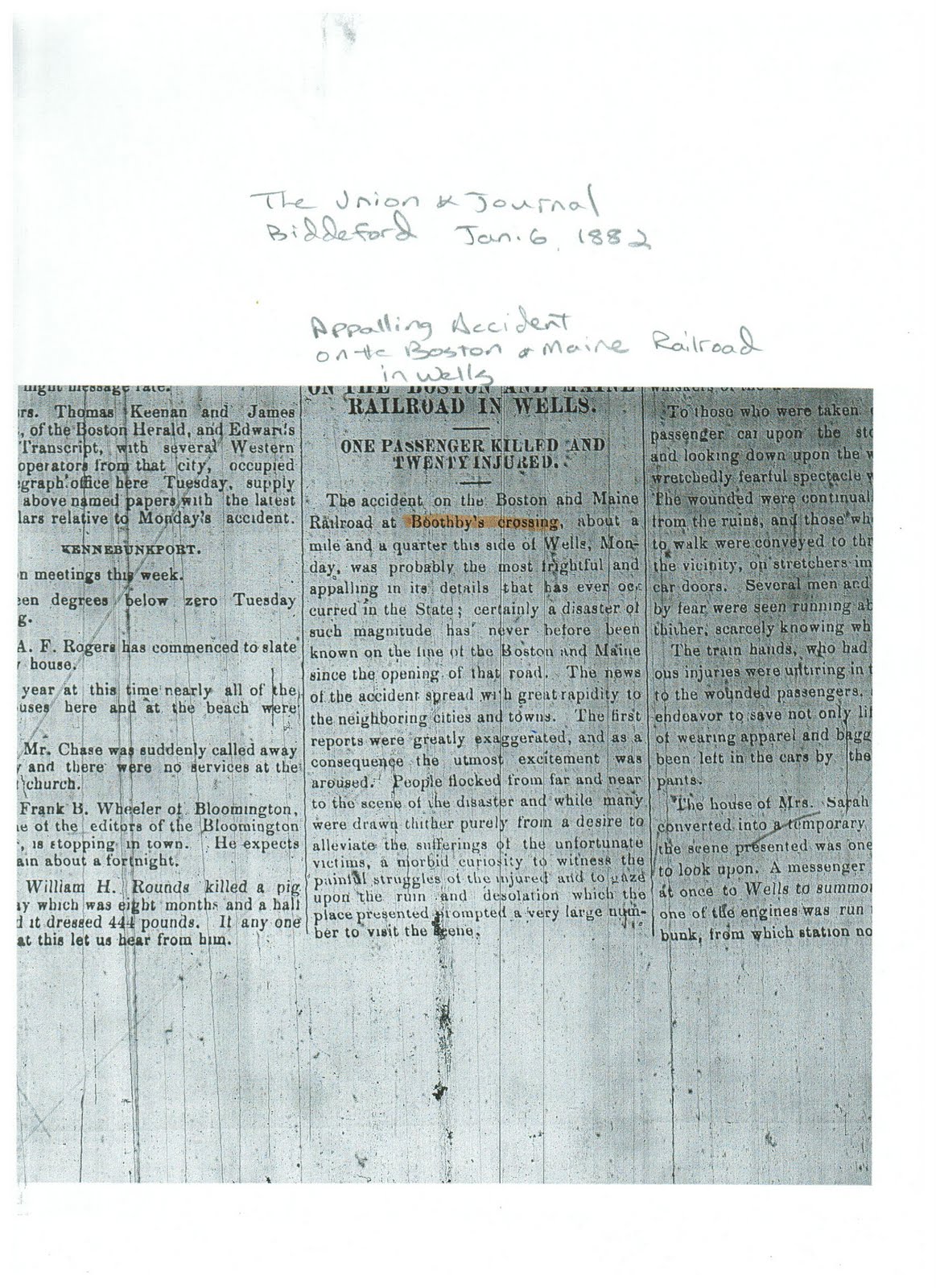
    An Appalling Accident - B&M Railroad
    January 6, 1882 in Wells, Maine
    So I quickly moved her to microfilm. At first glance, microfilm is exciting to a kid accustomed to a digital world. I held the film of an 1882 local newspaper up to the light to show her the image and showed her how to use the machine. She was uncomfortable with the streaks on the page and the inability to easily read the words, but when we found the first appropriate article there was excitement. Our diary mentions a train crash and there in The Union and Journal, 4 days after the accident (quite fitting for a weekly paper), was an article titled "Appalling Accident on the Boston and Maine Railroad in Wells." My research partner ran to her notebook to write the information while I printed the article.

    It took about half an hour to find the next related article, but such a long time between "finds" caused my research partner to lose interest. She very much wanted to participate, but microfilm was not her bag. I sent her to look through books  listing marriages in the town. We wanted the name of a particular minister who was mentioned as the person who married and buried a few people in our diary. When his name could not be found and the name of the people who were actually married couldn't be found, she was growing frustrated. While she searched, I continued to dig up articles related to some local deaths of people mentioned in the diary. Another exciting group of finds was articles about a court case related to a doctor being brought up on charges for a botched abortion. There were also more train crash articles.

    Kennebunkport Scandal - February 17, 1882
    After two hours of searching, we went for lunch. The enthusiasm did not return after some nourishment, so I took my daughter to the kids' room to find books, but my voracious reader didn't want them. "I want to help you mommy!" We tried for another half an hour to do some more research, but she was clearly done and I did not want to push it. I will see if the papers have been digitized and placed online (doubtful, but some towns are doing projects such as this). I will see if the next town in which we stop has the same paper, or I may need to return to Biddeford on my own one day to make my way through the rest of the microfilm.

    I learned two things on this trip and they were things I set out to learn.
    1. Our diary writer was not from Biddeford. Based on the articles and death notices, I now believe the gentleman is from Wells or Kennebunkport, Maine.
    2. My daughter is not ready for exactly this type of research yet. I suspected that. Knowing her personality, I also suspect she will want to try again when I start finding directory information. She has an inbred librarian gene and will enjoy looking up names when they are easier to come by. In the meantime, I have devised a new path for her end of the project. We are going to research the B&M railroad. She is going to make a map of its route through Maine, identifying local towns and diary landmarks such as the bridge into which the train crashed. Then she will dig into her crayons to decorate it. When enthusiasm wanes, teach little kids with craft projects!

    Thank you to Renee and Sharon at the McArthur Public Library in Biddeford, Maine for your help.

    Next stop: Kennebunk! Woo Woo!

    Wednesday, June 22, 2011

    The Diary Project Begins

    On this blog on May 6th, I introduced a diary I found in a local antique shop. The diary covers a six month period in 1882 and includes the names of many people, places, and events in Southern Maine. My elementary school aged daughter and I are about to embark on a summer history project. We hope to uncover the name of the person who wrote the diary and to find out more about this person's life.

    I spent a few weeks typing a transcript of the diary. My daughter's copy is to the left. She has spent some time highlighting the names of people, places, events and objects (important artifacts) mentioned. [She wanted to make sure I wrote "important artifacts" in this blog. She feels this conveys to the value of knowing items such as the instrument that our diary writer played.] This year my daughter learned how to make map keys in school. She locked onto the idea of making a key for the transcript. She has five highlighter colors. We just decided this morning that the fifth color would be for diseases she will identify in the diary. (It is very important for an eight year old girl to use all the colored markers at her disposal!)


    I have triangulated our diary between the areas of Biddeford, Saco, and Portland. The writer speaks of townspeople traveling among these areas. We have done just a little bit of Internet research to get us a started. Our diarist mentions the newspaper "Eastern Star." I keyed in on that to see if the publication was produced for one of the towns the diarist mentions. A paper by that title was indeed produced in Biddeford (and three other unfamiliar locations.) So, we are going to start in Biddeford.

    I contacted the reference desk at the MacArthur Public Library in Biddeford to plan our trip. It is a little strange being on the other end of an archives reference question. I introduced myself as an archivist and writer. I told one of the reference librarians about my project, asked questions about the hours that the local history collection / archives was available, and made sure that my proposed schedule would jive with them. The librarian seemed as excited about the diary as I. (It's so much fun to share a passion for information.)

    As I write this, my daughter is decorating a folder with stickers. She labeled it "Diary from Maine" on the front and has labeled each folder slot. She plans to put the "diary transcript" on one side and "diary research" on the other. Incorporating arts and crafts with research will probably be one key in keeping our project interesting for her. She is reading over my should now and asked if we can do more arts and crafts as we go. I said "Absolutely!" and here's what I am thinking...one of the places identified in our transcript is "Boothbys Bridge." If we can find more about it -- perhaps even get a picture of it -- we can make a likeness out of popsicle sticks. Perhaps we can make a collage with images of townspeople. We can make a mind map of the diseases we discover with information about them....I think the possible activities are endless.This project can take us on many great information adventures.

    I look forward to sharing these adventures with you too!